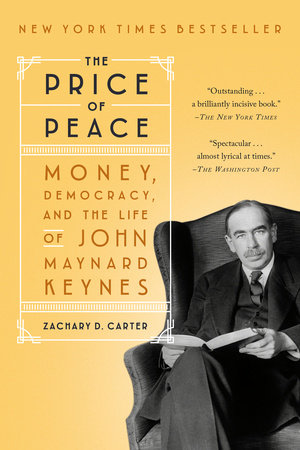
In The Price of Peace author Zachary D. Carter tells the story of John Maynard Keynes’ career, his significant contributions to world politics during both World Wars and The Great Depression, and his lasting impact on political and economic theory.
From early on, Keynes held the view that money was inherently a political part of society. As laid out in the first chapter of his A Treatise on Money, “To-day all civilised money is, beyond the possibility of dispute, chartalist.” The social nature of markets puts them at the mercy of (irrational) people trying to navigate an unknown future. Unexpected events, changing attitudes, flawed assumptions, and general uncertainty can prevent “free markets” from naturally self-correcting to equilibrium without potentially catastrophic instability. Economics could not be fully distilled into a hard science of mathematical proofs like physics. Given these shortcomings, Keynes believed governments needed to have the authority to structure, guide and – at times – manage markets in order to maintain “order, legitimacy, and confidence.”
This led to a big clash of ideals and of titans, pitting John Maynard Keynes and his “Keynesian” economics against Friedrich von Hayek, who pushed laissez-faire capitalism and neoliberalism. Hayek believed the world needed an upper class to transmit knowledge and define society’s values through the generations. After living through the Weimar Republic’s period of hyperinflation, what mattered to Hayek was “the rights of an aristocracy against the central government.” Keynes rejected Hayek’s ideas. To him, laissez-faire had led to vast inequality and social unrest.
In the post World War era, Paul Samuelson and Milton Friedman would also advocate for free-markets and try to fit economics into more of a pure science. For Samuelson, rational, profit-maximizing behavior would naturally lead to the supply-demand equilibriums of David Ricardo and Adam Smith. Meanwhile, Friedman believed “nothing could stand in the way of hard work and good ideas … there was no problem the market could not solve – even war.” True individual freedom came from man’s ability to participate in the market. During the Bill Clinton administration, these idealistic views of free markets, free trade, and globalization led to sweeping social changes. Clinton’s policies included government deregulation and the establishment of North American Free Trade Agreement (NAFTA) and the World Trade Organization (WTO). America did enjoy a brief period of unmatched prosperity, but income equality exploded in the 1990’s and the untethered financial markets eventually collapsed in the Great Recession.
As Carter writes, “The chief policy prescription of neoliberalism – let financial markets organize the distribution of resources and capital – had failed very publicly. Financial markets were obviously not rational – banks had blown themselves up – nor could they claim to offer a predictable, stable route to prosperity. The crash-induced recession had caused mass suffering.”
In contrast to laissez-faire and neoliberalism, Keynes argued for greater governmental authority in the economy to preserve social stability and prosperity. After World War I, he was against German reparations, predicting that the austerity measures required to make the debt repayments would breed resentment and social unrest (aka the rise of Hitler and World War II). In fact, he would become a lifelong enemy of austerity and, on the flip side, advocate for large government spending (investment) after deep recessions. Keynesian economic philosophy is most embodied by President Franklin D. Roosevelt’s New Deal, President Lyndon B. Johnson’s Great Society, and potentially President Joe Biden’s Infrastructure Bill. By alleviating poverty and bringing economic freedom, the government – Keynes believed – could produce a supportive society to ensure a “good life” for all (and not just Hayek’s aristocrats).
“[Keynes’] rubric for determining economic success or failure was not growth or productivity by “greatness”. There was objective aesthetic cultural achievements – Shakespeare – that economic policy was supposed to support.”
The Price of Peace, Zachary D. Carter
Keynesianism (which is John Maynard Keynes’ broader political philosophy vs. Keynesian which is mostly focused on economics?), Carter concludes, is “not so much a school of economic thought as a spirit of radical optimism”. It is a hopeful belief that with the right political leadership and steadying economic management, a democratic government could alleviate inequality, enable “artistic flowerings” (the Bloomsbury life), and encourage shared prosperity.
As further detailed in The Price of Peace, John Maynard Keynes did not live an easy life since his ideas were frequently “ahead of his time”. Nevertheless, he was courageous and pushed on until his death. I learned a lot about – and from – him while reading Carter’s book. The Price of Peace also also taught me more history, political theory and even some philosophy. While long (at over 650 pages), I did appreciate this read overall. It is obvious that Carter put a lot of work in bringing all of the ideas and concepts together. And I come away from it curious to learn more.
 Katie Quan