Lydgate Farms Chocolate Tasting

Kaua’i is the oldest of the Hawaiian Islands with the most developed soils and fertile growing conditions. Known as the “Garden Island”, it’s purported to be the largest coffee grower of the US (although I have to admit I was not a big fan of the coffee I tried there). One of the island’s many farms is Lydgate Farms – a family-run 46-acre farm now managed by Will Hibbs Lydgate.

Situated in Wailua, above the town of Kapa’a (Kaua’i’s most populous town), Lydgate Farms grows a variety of tropical fruit – like rambutan, apple banana, lilikoi (passion fruit), longyan, and soursop – and produces honey, vanilla and bean-to-bar chocolate. The farm offers a unique and comprehensive 3-hour long tour of the property, complete with a full tasting of all these products.

The tour was fully booked during our visit, but we drove up to the farm anyway hoping to at least buy some small chocolates from the store. We were treated to something much more special: a free chocolate tasting with Will Lydgate himself!

After introducing himself and giving the back-story of the farm, Will brought us over to a near-by cacao tree and picked a ripe pod right off the branch. With a well-used knife, he cut into the husk to reveal the inner beans and surrounding white pulp. “Taste this,” he said, entreating us each with a bean covered in white flesh. It was so sweet! I was instantly reminded of lychee and longyan – a soft, juicy fruit surrounding a hard seed. Then, Will had us bite into the seed itself – the part that eventually produces the chocolate. It was so bitter! As he went on to explain, the bitterness comes from toxic compounds that detract animals from eating it. To make the chocolate that we know and love, the seed needs to be fermented, roasted, ground, tempered and molded. Anything besides 100% chocolate has added sugar to offset the bean’s natural bitterness.

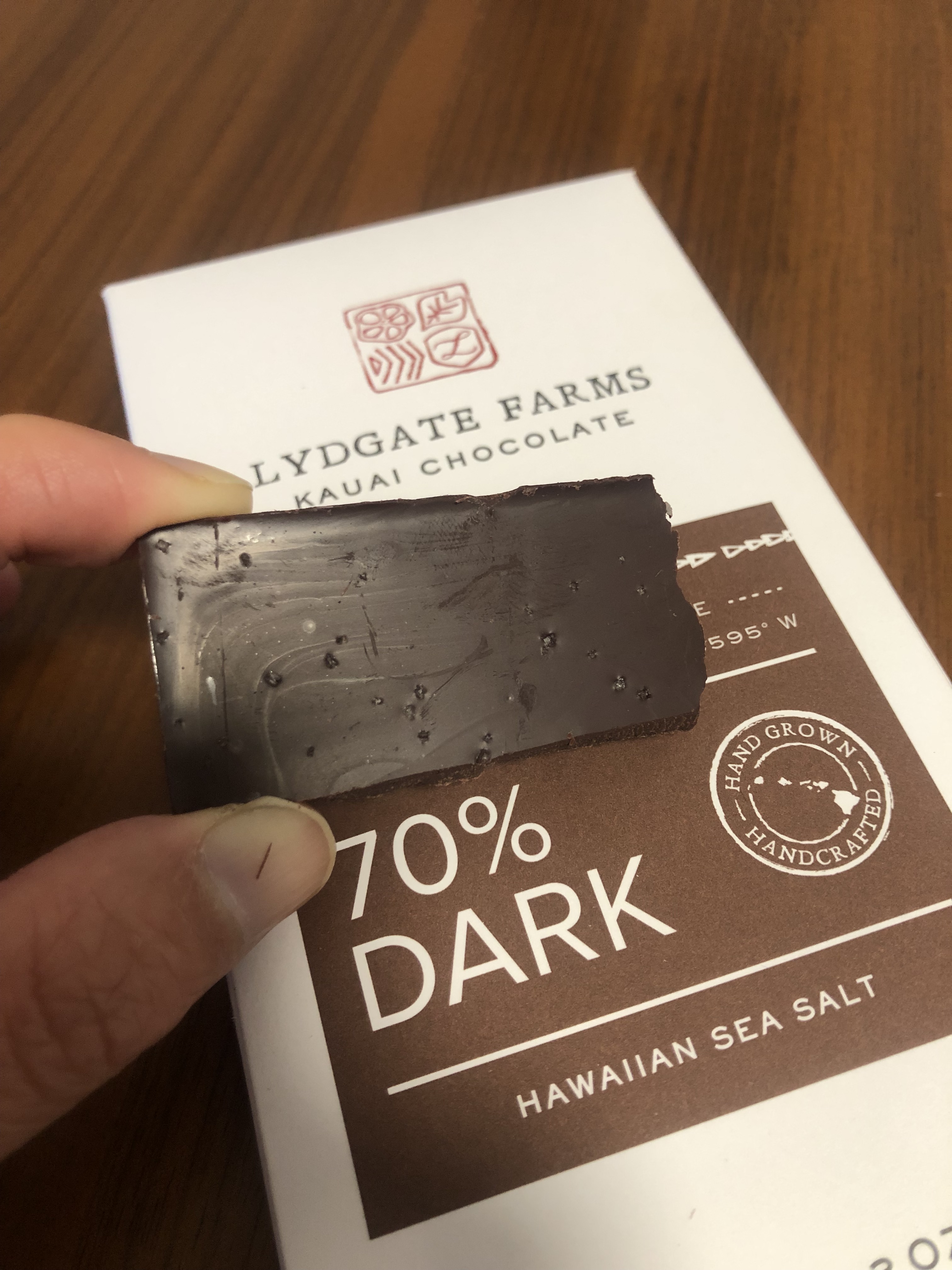
Once we’d had a chance to taste the raw ingredient, Will gave a sample of Lydgate Farm’s three different chocolate bars: a 70% dark chocolate, a 70% chocolate with Hawaiian salt, and a 50% milk chocolate with coffee and cacao nibs. Each of the chocolates were solid: great texture with a smooth mouth-feel as it melted, and – similar to the Maui Ku’ia Estate Chocolate we tasted before – the Lydgate Farm’s chocolate had a slightly brighter note, hinting at the tropical terroir. But, I thought the taste was pretty monotone throughout. There wasn’t a blooming of different flavors as the chocolate melted and covered my tongue. Of the three chocolates, I was surprised (again) that my favorite was the 50% milk with coffee and cacao nibs. There must be something about this flavor combination – chocolate and coffee – that really excites my taste buds. (I really liked the Mokka Cappuccino chocolate from Maui Ku’ia Estate Chocolate too.) The inclusions also give it a fun texture. My tongue would roll around the nibs while the chocolate melted. Will said that the milk chocolate is a common favorite amongst all customers.

But the tasting didn’t stop with just the chocolate! Will then had us taste two versions of his farm’s chocolate-covered macadamia nuts, a common Hawaiian treat. However, his may be the only one to use only Hawaiian grown chocolate and macadamia nuts. He even candied the macadamia nuts in honey produced on the farm. A lot of work in this one bite! How should I approach eating something so special? Should I be give the chocolate my full attention and lick the coating off the nut, and then appreciate the candied macadamia nut separately? Or should I have them together and just chomp through the whole thing? Luckily, he gave us two each, so I tried both approaches. Turns out it’s better to just be a (chocolate) monster and chomp away.

And there was still more treats! While he didn’t have any farm-produced vanilla available for us to taste, we got to sample their honey, which was very rich. The absolute highlight of the entire tasting though was a cacao nectar popsicle – something completely unique to his farm. The cacao nectar is made from the sweet white flesh inside the pod. Will is convinced that cacao nectar is one of the least known but amazing products out there that only South Americans are commercializing right now. He thinks it will blow-up and become mainstream in several years’ time. I hope he’s not wrong because the popsicle was honestly so refreshing and delicious. I’d love to be able to have that on hot summer days, along with whatever cacao nectar products there might be.

We felt so lucky as we left Lydgate Farms that afternoon (with a bag full of chocolate). Will was so generous in letting us try so many things. I wasn’t expecting to eat a cacao bean that day, let alone have a cacao nectar popsicle! He also did a great job of explaining the different steps in the chocolate production process on his farm, happy to answer any questions. If the full farm tour is conducted in the same manner, it’s definitely worth it. Thanks so much to Will and Lydgate Farms for the treats we were able to bring back all the way from Hawaii and are now enjoying in NYC. We’ll be waiting for those cacao nectar popsicles too.
https://lydgatefarms.com/

Maui Ku’ia Estate Chocolate Tasting

During one of our free afternoons while vacationing in Maui, Peter and I decided visit Maui Ku’ia Estate Cacao’s (MKEC) in Lāhainā where they were offering chocolate tastings (9 tastings for only $10!). We picked a few from their menu and took the little squares to their open rooftop to enjoy.

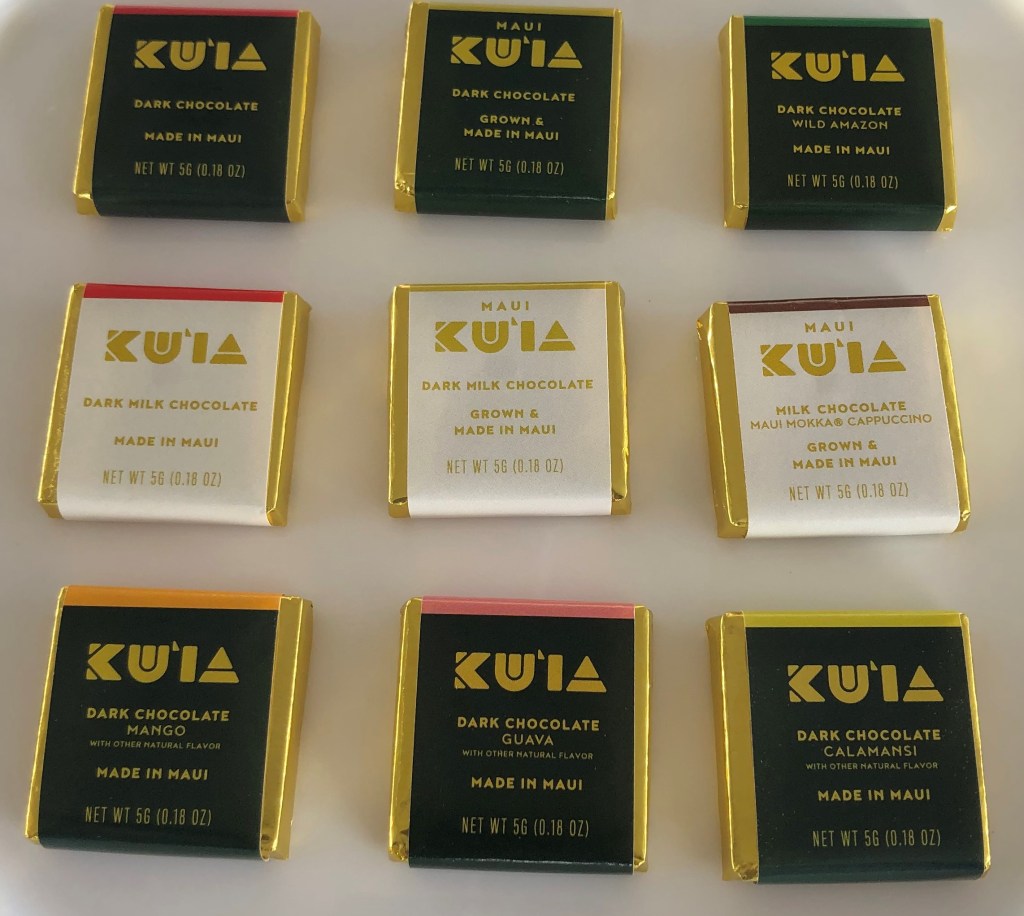
The 9 chocolates we sampled.

To appreciate MKEC’s selection of chocolates, it’s worth understanding the company’s backstory. CEO Gunars E. Valkirs began developing the farm with Dan O’Doherty in 2013. They started by planting cacao trees on the west side of Maui with windbreak and shade trees to protect the first ten acres. It took three years to fully develop. The second ten acres followed in 2017 and 2018. Unfortunately, Hurricane Lane and a Lahaina firestorm in August 2018 defoliated the entire cacao farm. After extensive pruning, the farm managed to harvest in 2019. The resulting small batch of chocolate was delicious. While MKEC is still committed to producing Maui-grown cacao, the farm’s growing capacity is limited to small batches. As MKEC continues to develop and expand, the company is importing unique cacao beans from an award-winning single-family estate in Ecuador and from the wild Amazon of Brazil to supplement its chocolate production. This is why MKEC offers a selection of chocolates made with not only Maui-grown cacao but also has chocolates made with cacao from South America.

The 9 chocolates we picked can be broken down into three overarching groups:

  • Top row: Dark chocolates. The first made with cacao from Costa Esmeraldas, an award-winning single-family estate in Ecuador. The second made with cacao grown on MKEC’s farm. The last was made with cacao found in the Brazilian Amazon.
  • Second row: Dark milk & milk chocolate. Again, the first made with cacao from Costa Esmeraldas, with the second made using Maui-grown cacao. The last was the only milk chocolate we sampled, flavored with Maui Mokka Cappuccino.
  • Third row: Flavored dark chocolates. All of the flavored chocolates were made with cacao from Costa Esmeraldas. MKEC had a variety of flavors, but we decided to go with the most tropical ones (in our opinion). Calamansi is a citrus fruit also known as Philippine lime or Philippine lemon. It was a new fruit to us that we discovered shortly before while camping in the Ho’omaluhia Botanical Gardens on Oahu.
    • After tasting everything, we got a bonus tasting of their “POG” flavored chocolate. POG stands for passion, orange, guava and is a common mixed-juice flavor in Hawaii.

My favorite grouping was (not totally surprisingly) the dark chocolate. The first dark chocolate made with Costa Esmeraldas cacao had the most familiar flavor profile to me. The taste starts out slightly acidic and bitter, but as the chocolate melts, it gives way to mellower tones of caramel and toffee. Meanwhile, the Maui-grown dark chocolate had a much brighter flavor. It really seemed to channel the tropical flavors associated with Hawaii (bananas, pineapples, papaya, mangoes, etc.). Even though this wasn’t a flavored chocolate, I was getting hints of guava as it melted in my mouth. The last dark chocolate was not at all what I was expecting. I thought it’d be a return to the flavors of the first chocolate from Ecuador. It was so much fruitier and, in fact, tasted like blueberries! I was very much reminded of the chocolate covered blueberries and acai berries from Brookside. It was a very unique treat. Of the three, the one from Brazil was definitely the most interesting to me, whereas Maui-grown chocolate was a bit too tropical for my palate.

Given this, perhaps it’s not surprising that the flavored dark chocolates were my least favorite group. In general, I do not like adding fruit to chocolate much. (In the typical assortment boxes of chocolates, I always disliked the ones with raspberry filling.) The only fruit flavor I enjoy with chocolate is coconut, which usually comes in the form of a dry, textured mix-in rather than an essence that is just blended into the chocolate. All of the tropical fruit flavored chocolates from this tasting just distracted from the underlying cacao flavors. For me, I think I would prefer to eat the actual fruit – so fresh and juicy in Hawaii! – separate from the chocolate and fully appreciate the flavors of each on its own.

The dark milk and milk chocolates were quite good! Chocolate snobs typically turn away from anything besides the most unaltered dark chocolates. I guess I’m not a chocolate snob, because I’ve found that I actually enjoy the balance between the more complex flavors of a dark chocolate and the smooth texture that the bit of extra milk adds in dark milk chocolates. The Askinosie 62% Dark Milk Chocolate (made with goat’s milk) was the first labeled “dark milk” chocolate I’ve ever had, and it remains one of my favorite chocolates. Between the Ecuadorian and Maui dark milk chocolates, I still preferred the one from Ecuador. Again, it was closer to the more traditional chocolate flavor profile that I seem to prefer over the tropical taste in the Maui chocolate. I was most surprised by the milk chocolate in this group though. With the added Mokka cappuccino flavor, I really felt like I was eating a tiramisu in chocolate form. Unlike the tropical fruit flavored dark chocolates, this cappuccino addition melded very well with the underlying creamy milk chocolate. I could easily see this piece being a crowd pleaser. I know my sweet tooth was fully satisfied by this dessert chocolate.

Peter and I had a great experience with this chocolate tasting, and I would highly recommend it to anyone who ends up visiting Maui. I was really able to appreciate how the terroir can effect the flavors of cacao in chocolate – much like how it impacts the flavors of grapes turned into wine. While Maui-grown chocolate might not be my favorite, it was fun discover how different the tastes of cacao produced in separate parts of the world could be. I also fully respect everything that Gunars is doing at MKEC. While the farm has not yet turned a profit, he is committed to donating 100% of future net profits to non-profit initiatives. He is essentially investing a large amount of personal capital into a passion project that will ultimately will go towards funding philanthropic work. And he is doing it in a sustainable way that will benefit the land, the employees and the community. It is inspiring work to see. Check them out, support what they’re doing, and get some delicious chocolate! They also make for great holiday gifts.

https://mauichocolate.com/

Chocolate Review: Element Truffles’ Black Lava Salt with Turmeric Chocolate Bar

Bar: Black Lava Salt with Turmeric
Maker: Elements Truffles
Chocolate Percentage: 75%
Price: $7/50g Bar
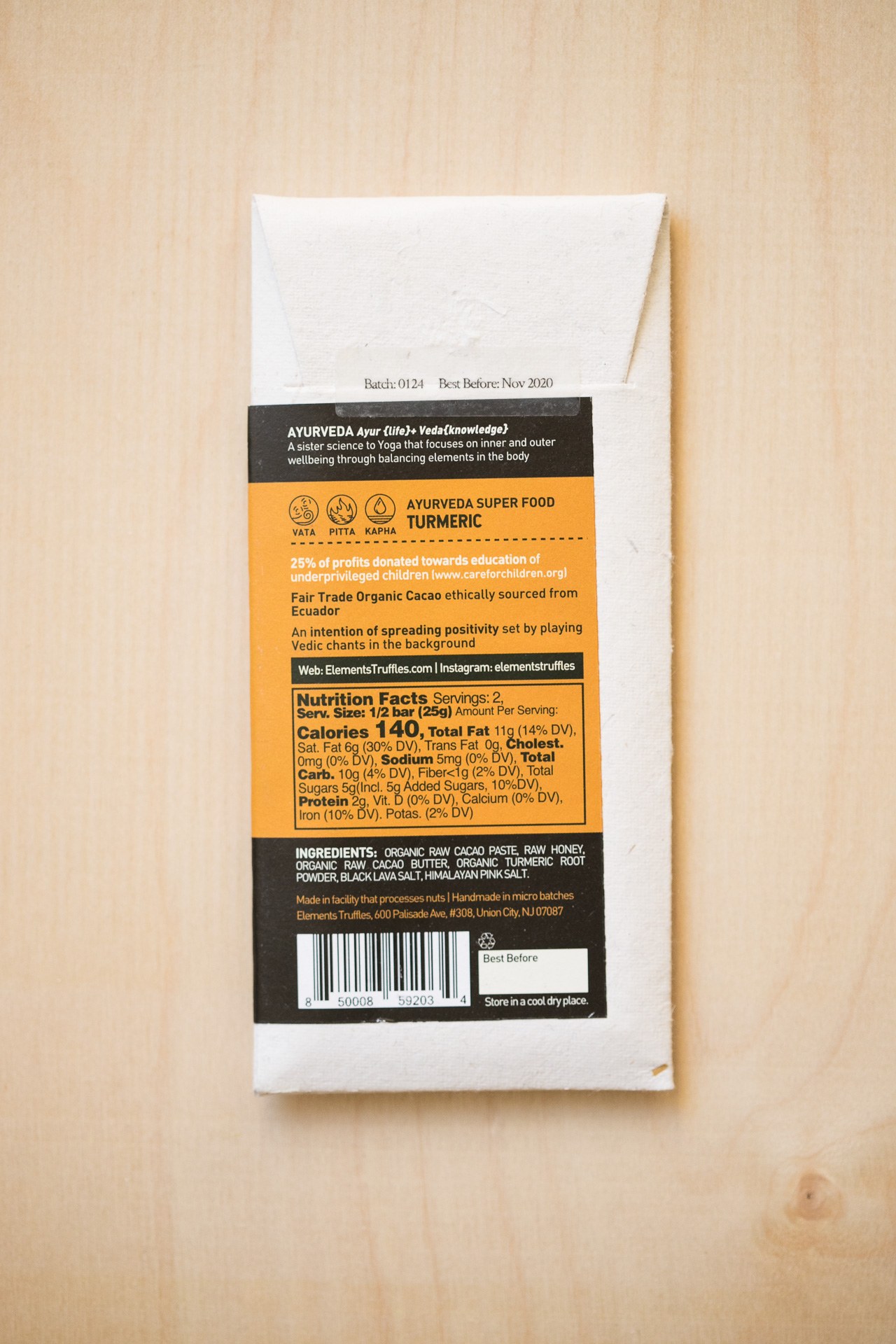
Ingredients: Organic Raw Cacao Paste, Raw Honey, Organic Raw Cacao Butter, Organic Turmeric Root Powder, Black Lava Salt, Himalayan Pink Salt
Additional Notes: Chocolate Origin: Ecuador

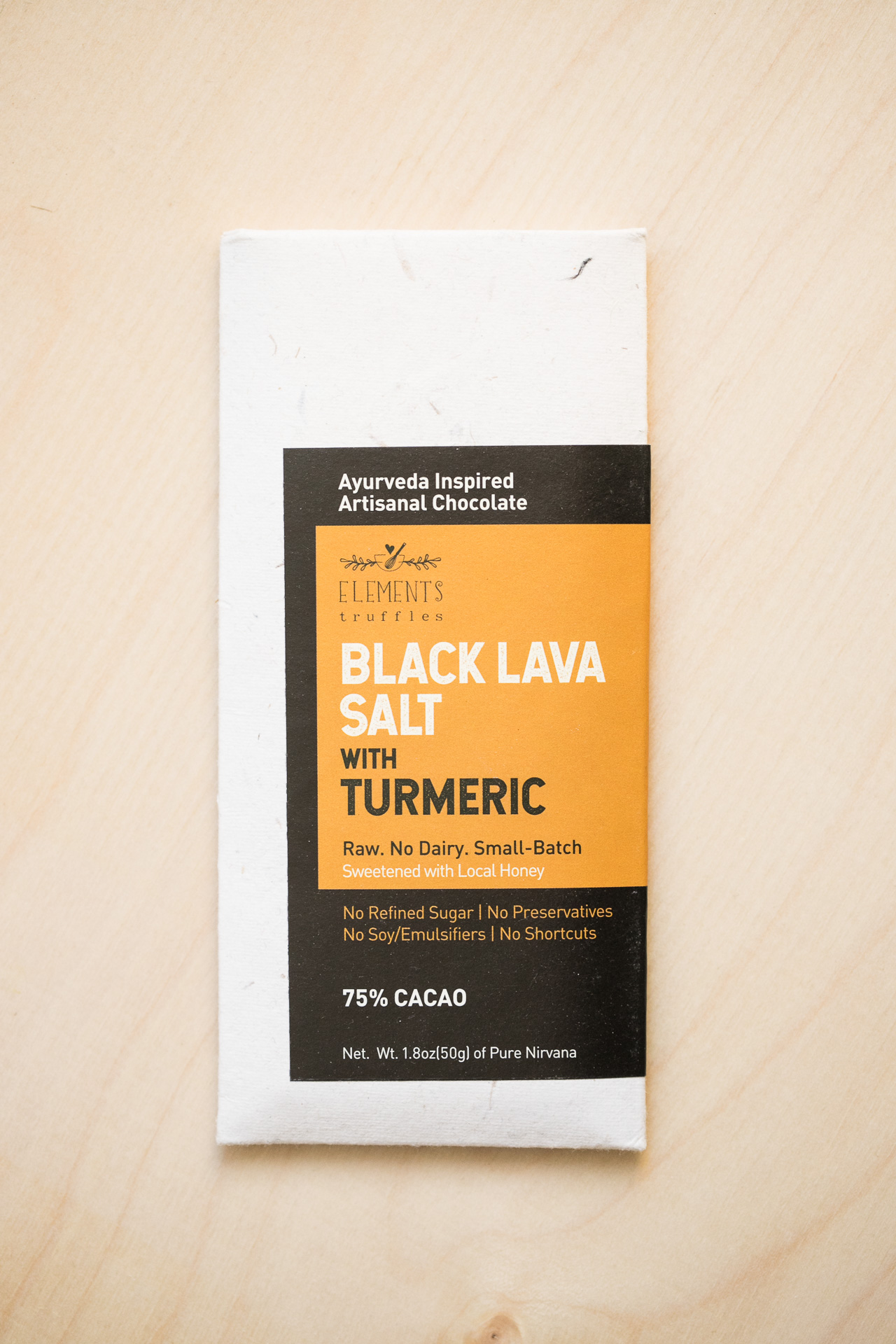
Packaging: “Ayurveda Inspired Artisanal Chocolate” makes me think this is a chocolate meant for yogis. Ayurveda, as explained by the back of the package, derives from Ayur (life) and Veda (knowledge), and it is a “sister science” to Yoga that focuses on inner and outer wellbeing through balancing elements in the body. So perhaps this is best enjoyed to further sweeten your yoga session?

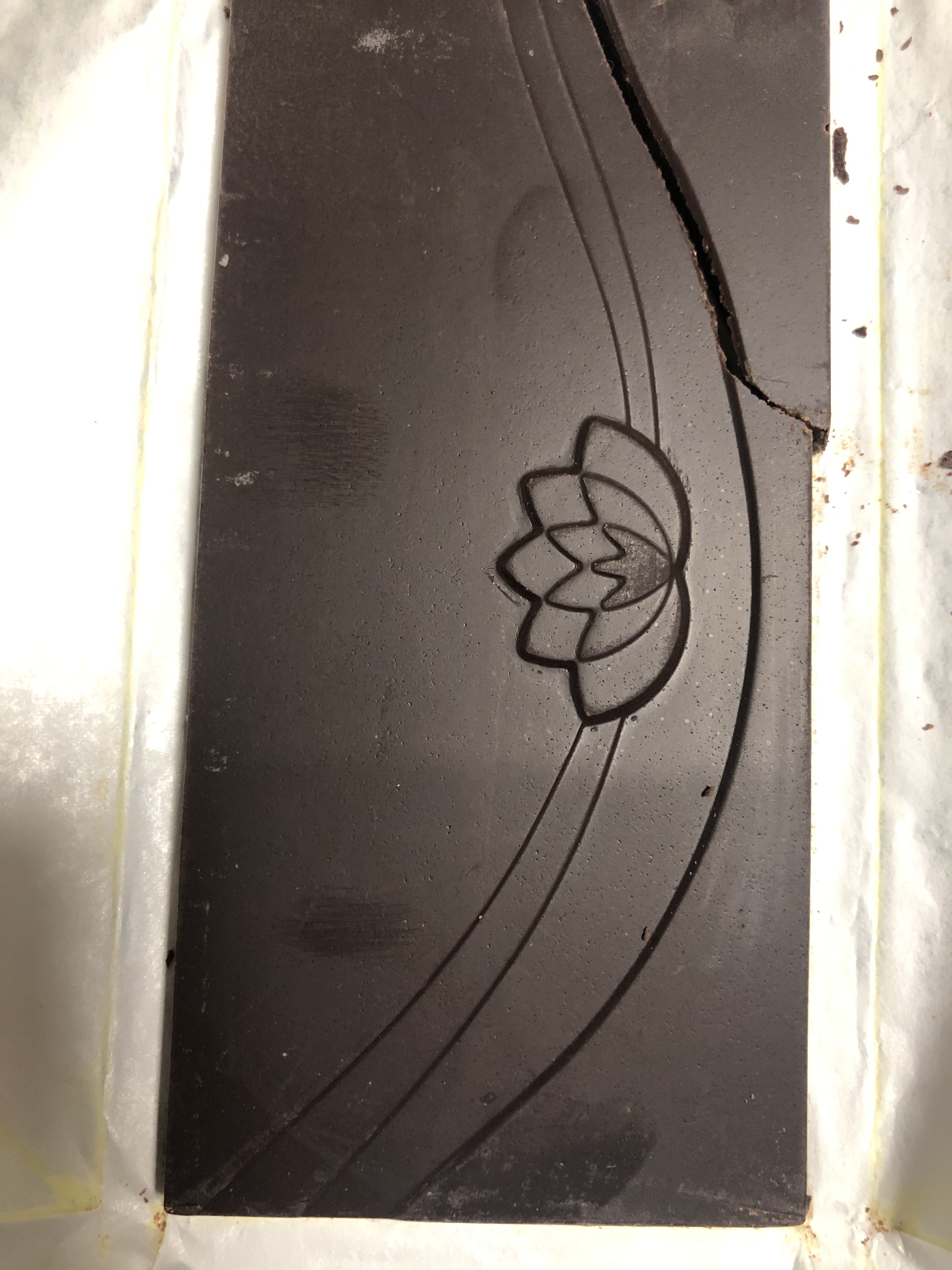
Appearance: The chocolate consists of a full, unsectioned bar with a lotus flower design to the side, adding to the whole spiritual and meditation theme of this product.
Aroma: The bar has a slight caramel like scent to it. Perhaps it comes from the combination of the dark chocolate with the honey. I don’t get any incense aromas. I guess it’s not that spiritual.
Melt & Snap: There snap is hard, but the chocolate melts nice and slowly. The texture is a little more gritty than the others. Maybe it has to do with the rawness of the chocolate? Or is it a consequence of the turmeric powder? I wasn’t sure. However, the grittiness was not at all unpleasant or distracting. The melt was quite satisfying.
Flavor: There honey flavor definitely comes through pretty strongly bringing a distinct sweetness to this chocolate. It really helps lighten the bitterness I would’ve expected from a 75% dark chocolate. I still think I would’ve preferred a regular sugar based sweetener though. I’m not sure that I got a distinct turmeric taste from the chocolate. I’m not sure what turmeric tastes like on its own to be honest. Overall, not a bad chocolate, but not my favorite either.

Chocolate Review: Dick Taylor 73% Dark with Fleur de Sel | Northerner Blend

Bar: Dick Taylor 73% Dark with Fleur de Sel | Northerner Blend
Maker: Dick Taylor Craft Chocolate
Chocolate Percentage: 73%
Price: $9.50 per 57g / 2oz bar (online)
Ingredients: Cacao*, Cane Sugar*, Fleur de Sel (*Organic)
Additional Notes: Chocolate Origin: Northerner Blend – Brazil & Madagascar

Packaging: The main focus on the front of the packaging has a block print drawing of a sailboat with its crew on the flat deck navigating the vessel in the expansive ocean with some picturesque clouds. Dick Taylor’s company logo and the name of the bar take the blank space in the sky about the boat.

Compared to the other chocolate bars, the back of this packaging is relatively simple. Another mostly black and white etching shows two workers harvesting salt. There are a few more informational details, like the fact that the salt in the bar is hand-harvested Guatamala sea salt by Bitterman Salt Co., and that the chocolate was handcrafted using traditional European techniques in Humboldt County, California. There is even a batch no stamped on. However, you’d have to go to the website to learn that the chocolate is a blend of Brazilian and Madagascan cacao sweetened with Brazilian cane sugar. The website also gives additional details about “Northerner Blend”, which I guess is their name for this chocolate bar.

The chocolate is wrapped in a gold plastic with the signature Dick Taylor diamond and designs that are also etched into the surface of the chocolate itself. I’d say this inner packaging and the design of the bar itself are more exquisite than the two previous bars. The back of the chocolate bar is smooth and does not have the imprint design.

Appearance: The front of the bar had a nice dark brownish red color with some little splotches of brighter red tints. The back of the bar was a noticeably lighter shade of brown. It looked like it bloomed. You could also see the flecks of sea salt on the back of the chocolate bar.
Aroma: Nothing besides the chocolate and sea salt. It is a two ingredient bar after all.
Melt & Snap: The chocolate didn’t melt at all and had a hard snap. I even felt like I had to chew the chocolate to eat it.
Flavor: I was fairly disappointed by the lack of flavor in this chocolate, which was easily overpowered by the sea salt. Both the texture and the taste make leads me to believe that despite the Best Before date not passing yet, the chocolate had turned bad while in transport or something wasn’t processed correctly. Before writing off Dick Taylor chocolate, I would want to try a different bar.