To build a successful company in today’s day and age, you need to employ smart creatives and construct teams that are “individually and collectively obsessed with what’s good for the company.” In turn, these high-performing teams require a great leader who is both a strong manager and a caring coach. Trillion Dollar Coach dives into the responsibilities of the ultimate coach, as inspired by Bill Campbell. Campbell coached Eric Schmidt and Jonathan Rosenberg (two of the book’s authors), Sundar Pichai and Ruth Porat, Steve Jobs, Jeff Bezos, Jack Dorsey, Sheryl Sandberg, and countless others. He is the “trillion dollar coach.”
Trillion Dollar Coach has four chapters with numerous governing leadership / coaching principles in each: 1) Your Title Makes You Manager. Your People Make You a Leader, 2) Build an Envelope of Trust, 3) Team First, and 4) The Power of Love. The following are my notes and take aways regrouped into the overarching themes I saw.
Picking the Right Players
- The top characteristics to look for are smarts and hearts: the ability to learn fast, a willingness to work hard, integrity, grit, empathy, and a team-first attitude.
- A big turnoff for Bill was if they were no longer learning.
- People who show up, work hard, and have an impact every day. Doers. “It’s not what you used to do, it’s not what you think, it’s what you do every day.”
- People who put team first. As Sundar Pichai says, “people who understand that their success depends on working well together, that there’s give-and-take — people who put the company first.”
- Bill valued courage: the willingness to take risks and the willingness to stand up for what’s right for the team, which may entail taking a personal risk.
Taking Care of the People
- It’s the People Manifesto:
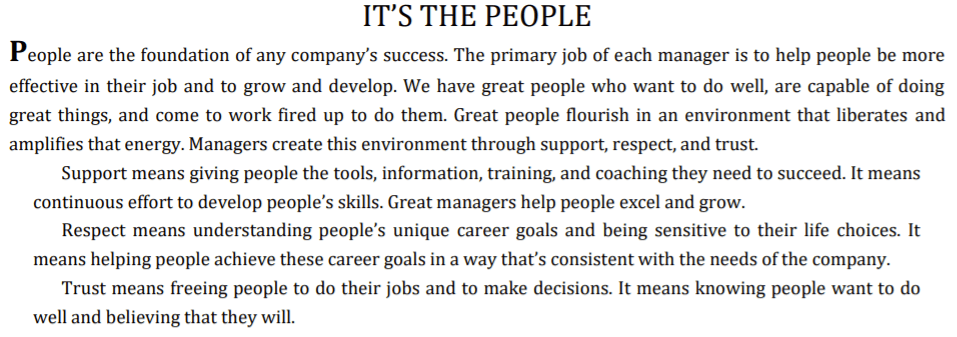
- The top priority of any manager is the well-being and success of her people.
- Most people don’t spend a lot of time thinking about how they are going to make someone else better. But that’s what coaches do.
- “Think that everyone who works for you is like your kids,” Bill once said. “Help them course correct, make them better.”
- Be relentlessly honest and candid, couple negative feedback with caring, give feedback as soon as possible, and if the feedback is negative, deliver it privately.
- Trust is the first thing to create if you want a relationship to be successful.
- Trust means people feel safe to vulnerable (psychological safety – one of the five factors of successful teams). Trust means you keep your word. Trust mean loyalty. Integrity. It means ability, the trust that you actually had the talent, skills, power, and diligence to accomplish what you promised. Trust means discretion.
- People are most effective when they can be completely themselves and bring their full identity to work
- Believe in people more than they believe in themselves, and push them to be more courageous.
Building the Team & Community
- Bill believed in striving for the best idea, not consensus. The goal of consensus leads to “groupthink” and inferior decisions. To avoid groupthink:
- Make sure that people have the opportunity to provide their authentic opinions, especially if they are dissenting.
- Help people prepare for group meetings. Have them think through and talk through their own perspective so they are ready to present it.
- Create an environment that is “safe for interpersonal risk taking … a teams climate … in which people are comfortable being themselves.”
- Winning depends on having the best team, and the best teams have more women.
- Bill thought peer relations were more important than relationships with your manager or other higher-ups. What do your teammates think of you? That’s what’s important!
- Seek opportunities to pair people up on projects or decisions. It will build a deeper sense of understanding between different team members.
- To build rapport and better relationships among team members, start team meetings with trip reports, or other types of more personal, non-business topics. The simple communication practice – getting people to share stories, to be personal with each other – was in fact a tactic to ensure better decision making and camaraderie.
- Most important issues cut across functions, but, more important, bringing them to the table in team meetings lets people understand what is going on in the other teams, and discussing them as a group helps develop understanding and build cross-functional strength.
- “Knowledge commonality” helps the team perform better and is well worth the time it requires.
- Getting to the right answer is important, but having the whole team get there is just as important.
- When two people disagree, have them figure it out together. It empowers the people working on the issue to figure out ways to solve the problem, a fundamental principle of successful mediation. And it forms a habit of working together to resolve conflict that pays off with better camaraderie and decision making for years afterword.
- Bill encouraged ensembles and always strived for a politics-free environment.
- Listen, observe, and fill the communication and understanding gaps between people.
Leadership and Decision Making
- When faced with a problem or opportunity, the first step is to ensure the right team is in place and working on it.
- Define the “first principles” for the situation, the immutable truths that are the foundation for the company or product, and help guide the decision from those principles.
- Identify the biggest problem, the “elephant in the room,” bring it front and center, and tackle it first.
- Failure to make a decision can be as damaging as a wrong decision. Having a well-run process to get to a decision is just as important as the decision itself, because it gives the team confidence and keeps everyone moving.
- The manager’s job is to run a decision-making process that ensures all perspectives get heard and considered, and, if necessary, to break ties and make the decision.
- When things are going bad, teams are looking for even more loyalty, commitment, and decisiveness from their leaders.
- Stay relentlessly positive. Positive leadership makes it easier to solve problems. Also be relentless in identifying and addressing problems. Stick to “problem-focused coping” in contrast to “emotion-focused coping”.
- Strive to win, but always win right, with commitment, teamwork, and integrity. Remember “the humanity of winning” by which he means winning as a team (not as individuals) and winning ethically.
- Harness the power of love:
- Be generous with your time, connections, and other resources.
- To care about people you have to care about people: ask about their lives outside of work, understand their families, and when things get rough, show up.
- Cheer demonstrably for people and their successes.
From these principles, it is clear that Adam Grant writes in the book’s forward is true. Trillion Dollar Coach belongs in the help-others section. “It’s a guide for bringing out the best in others, for being simultaneously supportive and challenging, and for giving more than lip service to the notion of putting people first.”
I had heard of Bill Campbell previously as a Columbia student-athlete. After graduating from Columbia University, he was an influential football coach from 1974 to 1979 and went on to become a trustee. The sports center at Baker Athletics Complex is named after him. After his passing in 2016, he was honored by the school in numerous ways for his leadership and generosity. I didn’t realize the scope of his positive influence on people until after reading this book. I feel inspired to try to live by some of these principles and follow his example to create a beneficial impact on my teams and in my community.
 Katie Quan