Trillion Dollar Coach

To build a successful company in today’s day and age, you need to employ smart creatives and construct teams that are “individually and collectively obsessed with what’s good for the company.” In turn, these high-performing teams require a great leader who is both a strong manager and a caring coach. Trillion Dollar Coach dives into the responsibilities of the ultimate coach, as inspired by Bill Campbell. Campbell coached Eric Schmidt and Jonathan Rosenberg (two of the book’s authors), Sundar Pichai and Ruth Porat, Steve Jobs, Jeff Bezos, Jack Dorsey, Sheryl Sandberg, and countless others. He is the “trillion dollar coach.”

Trillion Dollar Coach has four chapters with numerous governing leadership / coaching principles in each: 1) Your Title Makes You Manager. Your People Make You a Leader, 2) Build an Envelope of Trust, 3) Team First, and 4) The Power of Love. The following are my notes and take aways regrouped into the overarching themes I saw.

Picking the Right Players

  • The top characteristics to look for are smarts and hearts: the ability to learn fast, a willingness to work hard, integrity, grit, empathy, and a team-first attitude.
  • A big turnoff for Bill was if they were no longer learning.
  • People who show up, work hard, and have an impact every day. Doers. “It’s not what you used to do, it’s not what you think, it’s what you do every day.”
  • People who put team first. As Sundar Pichai says, “people who understand that their success depends on working well together, that there’s give-and-take — people who put the company first.”
  • Bill valued courage: the willingness to take risks and the willingness to stand up for what’s right for the team, which may entail taking a personal risk.

Taking Care of the People

  • It’s the People Manifesto:
  • The top priority of any manager is the well-being and success of her people.
  • Most people don’t spend a lot of time thinking about how they are going to make someone else better. But that’s what coaches do.
    • “Think that everyone who works for you is like your kids,” Bill once said. “Help them course correct, make them better.”
    • Be relentlessly honest and candid, couple negative feedback with caring, give feedback as soon as possible, and if the feedback is negative, deliver it privately.
  • Trust is the first thing to create if you want a relationship to be successful.
    • Trust means people feel safe to vulnerable (psychological safety – one of the five factors of successful teams). Trust means you keep your word. Trust mean loyalty. Integrity. It means ability, the trust that you actually had the talent, skills, power, and diligence to accomplish what you promised. Trust means discretion.
    • People are most effective when they can be completely themselves and bring their full identity to work
  • Believe in people more than they believe in themselves, and push them to be more courageous.

Building the Team & Community

  • Bill believed in striving for the best idea, not consensus. The goal of consensus leads to “groupthink” and inferior decisions. To avoid groupthink:
    • Make sure that people have the opportunity to provide their authentic opinions, especially if they are dissenting.
    • Help people prepare for group meetings. Have them think through and talk through their own perspective so they are ready to present it.
    • Create an environment that is “safe for interpersonal risk taking … a teams climate … in which people are comfortable being themselves.”
  • Winning depends on having the best team, and the best teams have more women.
  • Bill thought peer relations were more important than relationships with your manager or other higher-ups. What do your teammates think of you? That’s what’s important!
    • Seek opportunities to pair people up on projects or decisions. It will build a deeper sense of understanding between different team members.
    • To build rapport and better relationships among team members, start team meetings with trip reports, or other types of more personal, non-business topics. The simple communication practice – getting people to share stories, to be personal with each other – was in fact a tactic to ensure better decision making and camaraderie.
  • Most important issues cut across functions, but, more important, bringing them to the table in team meetings lets people understand what is going on in the other teams, and discussing them as a group helps develop understanding and build cross-functional strength.
  • “Knowledge commonality” helps the team perform better and is well worth the time it requires.
  • Getting to the right answer is important, but having the whole team get there is just as important.
    • When two people disagree, have them figure it out together. It empowers the people working on the issue to figure out ways to solve the problem, a fundamental principle of successful mediation. And it forms a habit of working together to resolve conflict that pays off with better camaraderie and decision making for years afterword.
    • Bill encouraged ensembles and always strived for a politics-free environment.
  • Listen, observe, and fill the communication and understanding gaps between people.

Leadership and Decision Making

  • When faced with a problem or opportunity, the first step is to ensure the right team is in place and working on it.
  • Define the “first principles” for the situation, the immutable truths that are the foundation for the company or product, and help guide the decision from those principles.
  • Identify the biggest problem, the “elephant in the room,” bring it front and center, and tackle it first.
  • Failure to make a decision can be as damaging as a wrong decision. Having a well-run process to get to a decision is just as important as the decision itself, because it gives the team confidence and keeps everyone moving.
  • The manager’s job is to run a decision-making process that ensures all perspectives get heard and considered, and, if necessary, to break ties and make the decision.
  • When things are going bad, teams are looking for even more loyalty, commitment, and decisiveness from their leaders.
  • Stay relentlessly positive. Positive leadership makes it easier to solve problems. Also be relentless in identifying and addressing problems. Stick to “problem-focused coping” in contrast to “emotion-focused coping”.
  • Strive to win, but always win right, with commitment, teamwork, and integrity. Remember “the humanity of winning” by which he means winning as a team (not as individuals) and winning ethically.
  • Harness the power of love:
    • Be generous with your time, connections, and other resources.
    • To care about people you have to care about people: ask about their lives outside of work, understand their families, and when things get rough, show up.
    • Cheer demonstrably for people and their successes.

From these principles, it is clear that Adam Grant writes in the book’s forward is true. Trillion Dollar Coach belongs in the help-others section. “It’s a guide for bringing out the best in others, for being simultaneously supportive and challenging, and for giving more than lip service to the notion of putting people first.”

I had heard of Bill Campbell previously as a Columbia student-athlete. After graduating from Columbia University, he was an influential football coach from 1974 to 1979 and went on to become a trustee. The sports center at Baker Athletics Complex is named after him. After his passing in 2016, he was honored by the school in numerous ways for his leadership and generosity. I didn’t realize the scope of his positive influence on people until after reading this book. I feel inspired to try to live by some of these principles and follow his example to create a beneficial impact on my teams and in my community.
The Price of Peace by Zachary D. Carter Notes

The Price of Peace by Zachary D. Carter

In The Price of Peace author Zachary D. Carter tells the story of John Maynard Keynes’ career, his significant contributions to world politics during both World Wars and The Great Depression, and his lasting impact on political and economic theory.

From early on, Keynes held the view that money was inherently a political part of society. As laid out in the first chapter of his A Treatise on Money, “To-day all civilised money is, beyond the possibility of dispute, chartalist.” The social nature of markets puts them at the mercy of (irrational) people trying to navigate an unknown future. Unexpected events, changing attitudes, flawed assumptions, and general uncertainty can prevent “free markets” from naturally self-correcting to equilibrium without potentially catastrophic instability. Economics could not be fully distilled into a hard science of mathematical proofs like physics. Given these shortcomings, Keynes believed governments needed to have the authority to structure, guide and – at times – manage markets in order to maintain “order, legitimacy, and confidence.”

This led to a big clash of ideals and of titans, pitting John Maynard Keynes and his “Keynesian” economics against Friedrich von Hayek, who pushed laissez-faire capitalism and neoliberalism. Hayek believed the world needed an upper class to transmit knowledge and define society’s values through the generations. After living through the Weimar Republic’s period of hyperinflation, what mattered to Hayek was “the rights of an aristocracy against the central government.” Keynes rejected Hayek’s ideas. To him, laissez-faire had led to vast inequality and social unrest.

In the post World War era, Paul Samuelson and Milton Friedman would also advocate for free-markets and try to fit economics into more of a pure science. For Samuelson, rational, profit-maximizing behavior would naturally lead to the supply-demand equilibriums of David Ricardo and Adam Smith. Meanwhile, Friedman believed “nothing could stand in the way of hard work and good ideas … there was no problem the market could not solve – even war.” True individual freedom came from man’s ability to participate in the market. During the Bill Clinton administration, these idealistic views of free markets, free trade, and globalization led to sweeping social changes. Clinton’s policies included government deregulation and the establishment of North American Free Trade Agreement (NAFTA) and the World Trade Organization (WTO). America did enjoy a brief period of unmatched prosperity, but income equality exploded in the 1990’s and the untethered financial markets eventually collapsed in the Great Recession.

As Carter writes, “The chief policy prescription of neoliberalism – let financial markets organize the distribution of resources and capital – had failed very publicly. Financial markets were obviously not rational – banks had blown themselves up – nor could they claim to offer a predictable, stable route to prosperity. The crash-induced recession had caused mass suffering.”

In contrast to laissez-faire and neoliberalism, Keynes argued for greater governmental authority in the economy to preserve social stability and prosperity. After World War I, he was against German reparations, predicting that the austerity measures required to make the debt repayments would breed resentment and social unrest (aka the rise of Hitler and World War II). In fact, he would become a lifelong enemy of austerity and, on the flip side, advocate for large government spending (investment) after deep recessions. Keynesian economic philosophy is most embodied by President Franklin D. Roosevelt’s New Deal, President Lyndon B. Johnson’s Great Society, and potentially President Joe Biden’s Infrastructure Bill. By alleviating poverty and bringing economic freedom, the government – Keynes believed – could produce a supportive society to ensure a “good life” for all (and not just Hayek’s aristocrats).

“[Keynes’] rubric for determining economic success or failure was not growth or productivity by “greatness”. There was objective aesthetic cultural achievements – Shakespeare – that economic policy was supposed to support.”

The Price of Peace, Zachary D. Carter

Keynesianism (which is John Maynard Keynes’ broader political philosophy vs. Keynesian which is mostly focused on economics?), Carter concludes, is “not so much a school of economic thought as a spirit of radical optimism”. It is a hopeful belief that with the right political leadership and steadying economic management, a democratic government could alleviate inequality, enable “artistic flowerings” (the Bloomsbury life), and encourage shared prosperity.

As further detailed in The Price of Peace, John Maynard Keynes did not live an easy life since his ideas were frequently “ahead of his time”. Nevertheless, he was courageous and pushed on until his death. I learned a lot about – and from – him while reading Carter’s book. The Price of Peace also also taught me more history, political theory and even some philosophy. While long (at over 650 pages), I did appreciate this read overall. It is obvious that Carter put a lot of work in bringing all of the ideas and concepts together. And I come away from it curious to learn more.

Lydgate Farms Chocolate Tasting

Kaua’i is the oldest of the Hawaiian Islands with the most developed soils and fertile growing conditions. Known as the “Garden Island”, it’s purported to be the largest coffee grower of the US (although I have to admit I was not a big fan of the coffee I tried there). One of the island’s many farms is Lydgate Farms – a family-run 46-acre farm now managed by Will Hibbs Lydgate.

Situated in Wailua, above the town of Kapa’a (Kaua’i’s most populous town), Lydgate Farms grows a variety of tropical fruit – like rambutan, apple banana, lilikoi (passion fruit), longyan, and soursop – and produces honey, vanilla and bean-to-bar chocolate. The farm offers a unique and comprehensive 3-hour long tour of the property, complete with a full tasting of all these products.

The tour was fully booked during our visit, but we drove up to the farm anyway hoping to at least buy some small chocolates from the store. We were treated to something much more special: a free chocolate tasting with Will Lydgate himself!

After introducing himself and giving the back-story of the farm, Will brought us over to a near-by cacao tree and picked a ripe pod right off the branch. With a well-used knife, he cut into the husk to reveal the inner beans and surrounding white pulp. “Taste this,” he said, entreating us each with a bean covered in white flesh. It was so sweet! I was instantly reminded of lychee and longyan – a soft, juicy fruit surrounding a hard seed. Then, Will had us bite into the seed itself – the part that eventually produces the chocolate. It was so bitter! As he went on to explain, the bitterness comes from toxic compounds that detract animals from eating it. To make the chocolate that we know and love, the seed needs to be fermented, roasted, ground, tempered and molded. Anything besides 100% chocolate has added sugar to offset the bean’s natural bitterness.

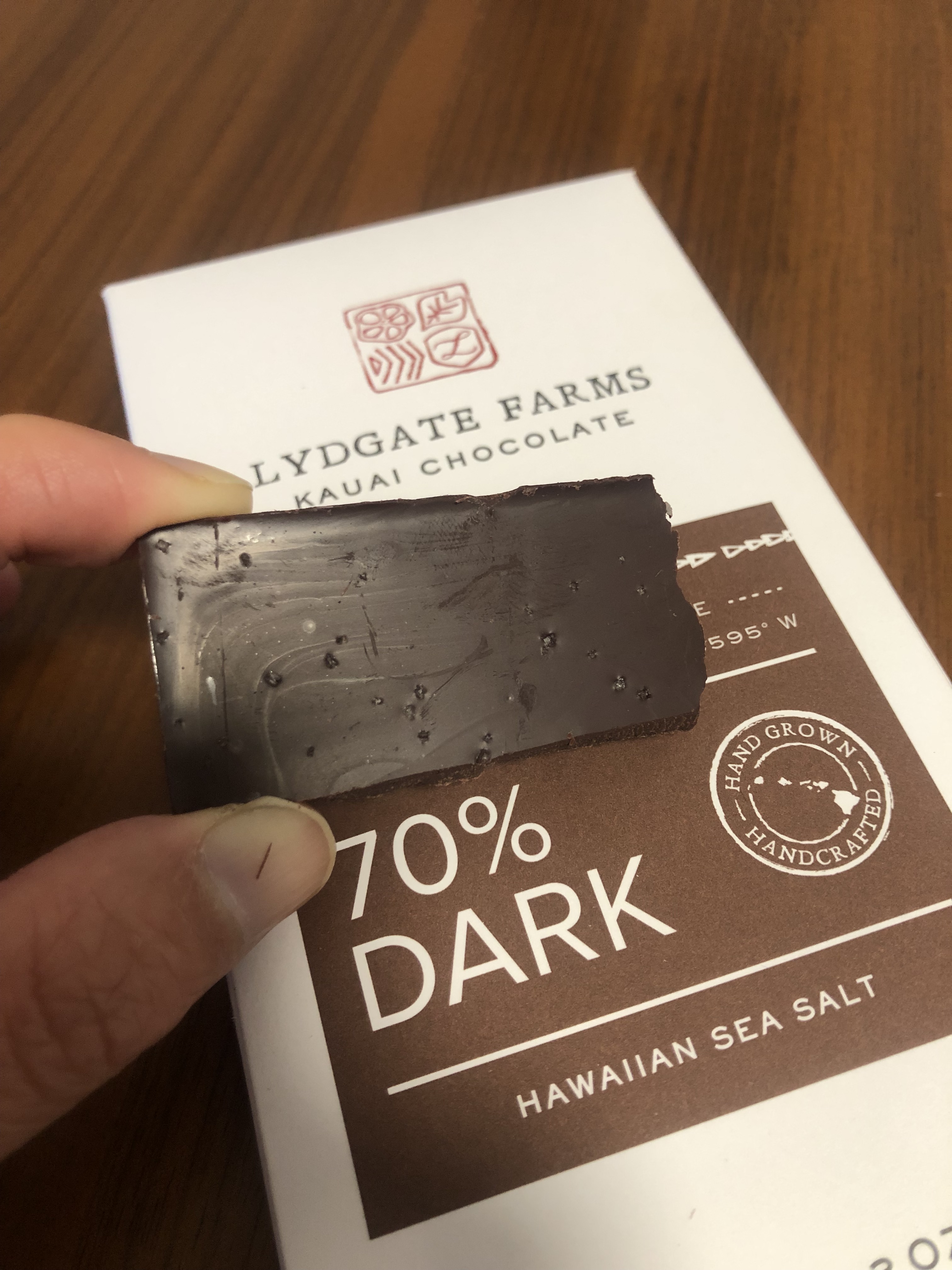
Once we’d had a chance to taste the raw ingredient, Will gave a sample of Lydgate Farm’s three different chocolate bars: a 70% dark chocolate, a 70% chocolate with Hawaiian salt, and a 50% milk chocolate with coffee and cacao nibs. Each of the chocolates were solid: great texture with a smooth mouth-feel as it melted, and – similar to the Maui Ku’ia Estate Chocolate we tasted before – the Lydgate Farm’s chocolate had a slightly brighter note, hinting at the tropical terroir. But, I thought the taste was pretty monotone throughout. There wasn’t a blooming of different flavors as the chocolate melted and covered my tongue. Of the three chocolates, I was surprised (again) that my favorite was the 50% milk with coffee and cacao nibs. There must be something about this flavor combination – chocolate and coffee – that really excites my taste buds. (I really liked the Mokka Cappuccino chocolate from Maui Ku’ia Estate Chocolate too.) The inclusions also give it a fun texture. My tongue would roll around the nibs while the chocolate melted. Will said that the milk chocolate is a common favorite amongst all customers.

But the tasting didn’t stop with just the chocolate! Will then had us taste two versions of his farm’s chocolate-covered macadamia nuts, a common Hawaiian treat. However, his may be the only one to use only Hawaiian grown chocolate and macadamia nuts. He even candied the macadamia nuts in honey produced on the farm. A lot of work in this one bite! How should I approach eating something so special? Should I be give the chocolate my full attention and lick the coating off the nut, and then appreciate the candied macadamia nut separately? Or should I have them together and just chomp through the whole thing? Luckily, he gave us two each, so I tried both approaches. Turns out it’s better to just be a (chocolate) monster and chomp away.

And there was still more treats! While he didn’t have any farm-produced vanilla available for us to taste, we got to sample their honey, which was very rich. The absolute highlight of the entire tasting though was a cacao nectar popsicle – something completely unique to his farm. The cacao nectar is made from the sweet white flesh inside the pod. Will is convinced that cacao nectar is one of the least known but amazing products out there that only South Americans are commercializing right now. He thinks it will blow-up and become mainstream in several years’ time. I hope he’s not wrong because the popsicle was honestly so refreshing and delicious. I’d love to be able to have that on hot summer days, along with whatever cacao nectar products there might be.

We felt so lucky as we left Lydgate Farms that afternoon (with a bag full of chocolate). Will was so generous in letting us try so many things. I wasn’t expecting to eat a cacao bean that day, let alone have a cacao nectar popsicle! He also did a great job of explaining the different steps in the chocolate production process on his farm, happy to answer any questions. If the full farm tour is conducted in the same manner, it’s definitely worth it. Thanks so much to Will and Lydgate Farms for the treats we were able to bring back all the way from Hawaii and are now enjoying in NYC. We’ll be waiting for those cacao nectar popsicles too.

https://lydgatefarms.com/

Maui Ku’ia Estate Chocolate Tasting

During one of our free afternoons while vacationing in Maui, Peter and I decided visit Maui Ku’ia Estate Cacao’s (MKEC) in Lāhainā where they were offering chocolate tastings (9 tastings for only $10!). We picked a few from their menu and took the little squares to their open rooftop to enjoy.

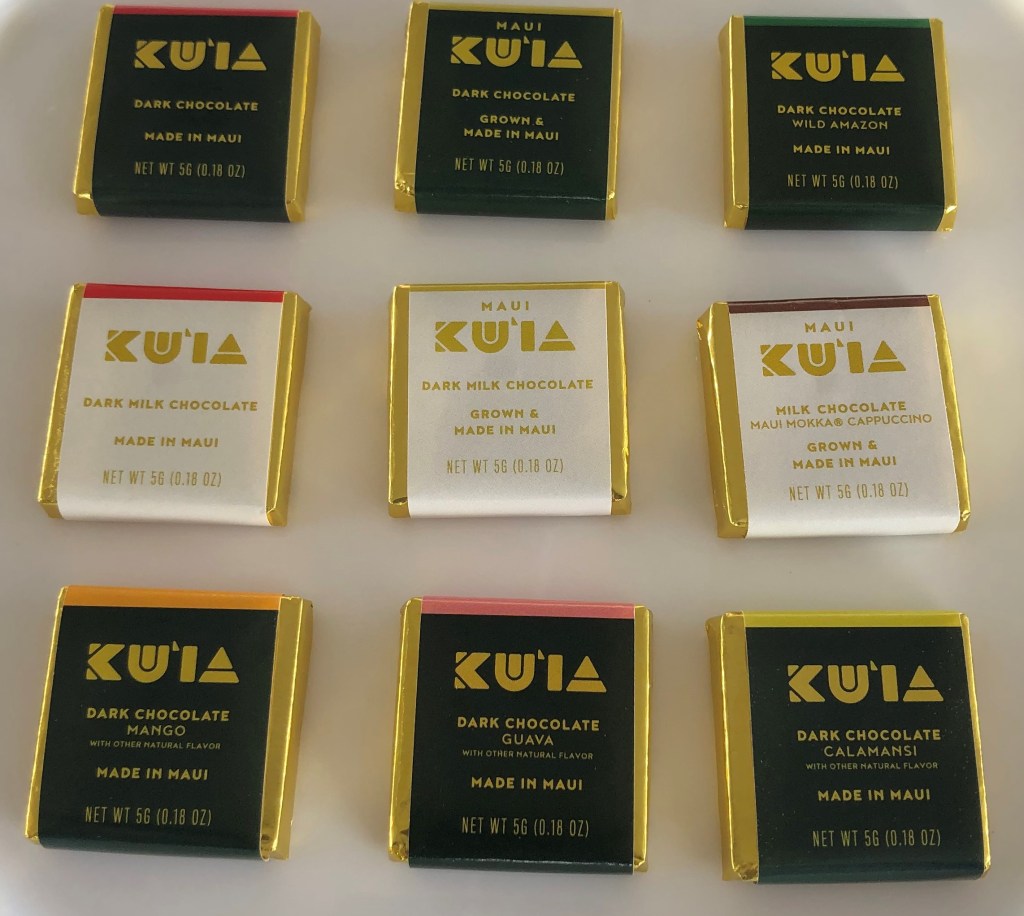
The 9 chocolates we sampled.

To appreciate MKEC’s selection of chocolates, it’s worth understanding the company’s backstory. CEO Gunars E. Valkirs began developing the farm with Dan O’Doherty in 2013. They started by planting cacao trees on the west side of Maui with windbreak and shade trees to protect the first ten acres. It took three years to fully develop. The second ten acres followed in 2017 and 2018. Unfortunately, Hurricane Lane and a Lahaina firestorm in August 2018 defoliated the entire cacao farm. After extensive pruning, the farm managed to harvest in 2019. The resulting small batch of chocolate was delicious. While MKEC is still committed to producing Maui-grown cacao, the farm’s growing capacity is limited to small batches. As MKEC continues to develop and expand, the company is importing unique cacao beans from an award-winning single-family estate in Ecuador and from the wild Amazon of Brazil to supplement its chocolate production. This is why MKEC offers a selection of chocolates made with not only Maui-grown cacao but also has chocolates made with cacao from South America.

The 9 chocolates we picked can be broken down into three overarching groups:

  • Top row: Dark chocolates. The first made with cacao from Costa Esmeraldas, an award-winning single-family estate in Ecuador. The second made with cacao grown on MKEC’s farm. The last was made with cacao found in the Brazilian Amazon.
  • Second row: Dark milk & milk chocolate. Again, the first made with cacao from Costa Esmeraldas, with the second made using Maui-grown cacao. The last was the only milk chocolate we sampled, flavored with Maui Mokka Cappuccino.
  • Third row: Flavored dark chocolates. All of the flavored chocolates were made with cacao from Costa Esmeraldas. MKEC had a variety of flavors, but we decided to go with the most tropical ones (in our opinion). Calamansi is a citrus fruit also known as Philippine lime or Philippine lemon. It was a new fruit to us that we discovered shortly before while camping in the Ho’omaluhia Botanical Gardens on Oahu.
    • After tasting everything, we got a bonus tasting of their “POG” flavored chocolate. POG stands for passion, orange, guava and is a common mixed-juice flavor in Hawaii.

My favorite grouping was (not totally surprisingly) the dark chocolate. The first dark chocolate made with Costa Esmeraldas cacao had the most familiar flavor profile to me. The taste starts out slightly acidic and bitter, but as the chocolate melts, it gives way to mellower tones of caramel and toffee. Meanwhile, the Maui-grown dark chocolate had a much brighter flavor. It really seemed to channel the tropical flavors associated with Hawaii (bananas, pineapples, papaya, mangoes, etc.). Even though this wasn’t a flavored chocolate, I was getting hints of guava as it melted in my mouth. The last dark chocolate was not at all what I was expecting. I thought it’d be a return to the flavors of the first chocolate from Ecuador. It was so much fruitier and, in fact, tasted like blueberries! I was very much reminded of the chocolate covered blueberries and acai berries from Brookside. It was a very unique treat. Of the three, the one from Brazil was definitely the most interesting to me, whereas Maui-grown chocolate was a bit too tropical for my palate.

Given this, perhaps it’s not surprising that the flavored dark chocolates were my least favorite group. In general, I do not like adding fruit to chocolate much. (In the typical assortment boxes of chocolates, I always disliked the ones with raspberry filling.) The only fruit flavor I enjoy with chocolate is coconut, which usually comes in the form of a dry, textured mix-in rather than an essence that is just blended into the chocolate. All of the tropical fruit flavored chocolates from this tasting just distracted from the underlying cacao flavors. For me, I think I would prefer to eat the actual fruit – so fresh and juicy in Hawaii! – separate from the chocolate and fully appreciate the flavors of each on its own.

The dark milk and milk chocolates were quite good! Chocolate snobs typically turn away from anything besides the most unaltered dark chocolates. I guess I’m not a chocolate snob, because I’ve found that I actually enjoy the balance between the more complex flavors of a dark chocolate and the smooth texture that the bit of extra milk adds in dark milk chocolates. The Askinosie 62% Dark Milk Chocolate (made with goat’s milk) was the first labeled “dark milk” chocolate I’ve ever had, and it remains one of my favorite chocolates. Between the Ecuadorian and Maui dark milk chocolates, I still preferred the one from Ecuador. Again, it was closer to the more traditional chocolate flavor profile that I seem to prefer over the tropical taste in the Maui chocolate. I was most surprised by the milk chocolate in this group though. With the added Mokka cappuccino flavor, I really felt like I was eating a tiramisu in chocolate form. Unlike the tropical fruit flavored dark chocolates, this cappuccino addition melded very well with the underlying creamy milk chocolate. I could easily see this piece being a crowd pleaser. I know my sweet tooth was fully satisfied by this dessert chocolate.

Peter and I had a great experience with this chocolate tasting, and I would highly recommend it to anyone who ends up visiting Maui. I was really able to appreciate how the terroir can effect the flavors of cacao in chocolate – much like how it impacts the flavors of grapes turned into wine. While Maui-grown chocolate might not be my favorite, it was fun discover how different the tastes of cacao produced in separate parts of the world could be. I also fully respect everything that Gunars is doing at MKEC. While the farm has not yet turned a profit, he is committed to donating 100% of future net profits to non-profit initiatives. He is essentially investing a large amount of personal capital into a passion project that will ultimately will go towards funding philanthropic work. And he is doing it in a sustainable way that will benefit the land, the employees and the community. It is inspiring work to see. Check them out, support what they’re doing, and get some delicious chocolate! They also make for great holiday gifts.

https://mauichocolate.com/

Some Guidance on Public Speaking

Driven by the goal of improving my public speaking and negotiating skills, I recently dove into three books: How to Win Friends and Influence People, Quiet and Talk Like Ted. While written for slightly different purposes, these texts had a few, core overlapping ideas I found instructive.

Impressions matter

Body language, charisma, and confidence all influence the impressions we impart on other people. And, while it may be unfair at times, first impressions and people’s perceptions of us can greatly affect our future success. Positive and charismatic leaders, aka “extroverts”, who can lead discussions, make presentations, and engage dynamically in conversations, appear more intelligent and more authoritative. This gives them more power and increases the likelihood they will be taken seriously and that their suggestions will be put into action.

In Quiet, Susan Cain writes, “We perceive talkers as smarter than quiet types. We also see talkers as leaders. The more a person talks, the more other group members direct their attention to him, which means that he becomes increasingly powerful as a meeting goes on. It also helps to speak fast; we rate quick talkers as more capable and appealing than slow talkers.”

What is particularly important here, is that the enthusiastic leader lifts the moods of others through his/her positivity. Positive emotions are contagious and help rally support. As Carmine Gallo says in Talk Like Ted, “Charismatic leadership is linked to organizational success because charismatic leaders enable their followers to experience positive emotions.”

Interestingly, in many cases, it doesn’t matter if these leaders are right. They are the people who are remembered and whose instructions are followed when the meeting is adjourned. This means that if you want your ideas to be taken seriously, you have to deliver them convincingly, with confidence and positivity. (But of course it also helps to be right.)

But what if confidence and charisma do not come naturally to you? That brings us to the next core idea.

Use physical behavior to guide your emotions and build up confidence and charisma

In Talk like Ted, Amy Cuddy, a social psychologist at HBS, says, “Our bodies change our minds, and our minds can change our behavior, and our behavior can change our outcomes.”

Perhaps the most important behavior touted in both How to Win Friends and Influence People and Quiet is smiling. In fact, in How to Win Friends and Influence People, Dale Carnegie lists the simple smile as the second principle in his six ways to make people like you. Smiling (our body) helps create a positive internal attitude (our mind) that is reflected in our actions (our behavior). And in Quiet, Susan Cain connects those behaviors to Cuddy’s outcomes. She writes, “We must smile so that our interlocutors will smile upon us. Taking these steps will make us feel good – and the better we feel, the better we can sell ourselves.”

Carmine Gallo would add that having “command presence” – the look of authority – could also instill confidence in ourselves and attract followers. He writes in Talk like Ted, “How we use our bodies – our nonverbal cues – can change people’s perceptions of us. Simply changing your body position affects how you feel about yourself and, by default, how others see you. Even if you don’t feel confident, act like it and your chances of success greatly improve.”

So, as the saying goes, “fake it until you make it.” Smile and take on strong body language to trick yourself into being more confident and charismatic. This will at least get you part of the way there … Like any other skill you’re looking to acquire, true mastery will only come with practice, which is the next main idea.

Public speaking takes practice

Even if you feel like you are not a natural extrovert or public speaker, there is still hope. In Quiet, Susan Cain says that according to Free Trait Theory, we may be born and culturally endowed with certain personality traits, but we can act out of character. An introvert can still rise up to be an inspiring public speaker. It just takes practice.

Deliberate practice strengthens the “muscles” associated with any skill, and, with public speaking in particular, it seems that practice can bring about actual structural brain changes that makes it easier over time.

As Gallo writes in Talk like Ted, “The brain areas involved in language – the areas that help you talk and explain ideas more clearly – these brain areas become more activated and more efficient the more they are used. The more you speak in public, the more the actual structure of the brain changes. If you speak a lot in public, language areas of the brain become more developed.”

Having more opportunities to practice public speaking also increases exposure to any potential fears. Over time, that fear will become desensitized, making future public speaking occasions easier to handle. In How to Win Friends and Influence People, Dale Carnegie also highlighted that “learning is an active process,” and that “we learn by doing.” As he writes, “You are attempting a new way of life. That will require time and persistence and daily application.”

Practice is hard. Being patient to persist over time is also hard, especially if it involves overcoming your fears. You need passion to help you see it through. That is the last idea.

Being a convincing and inspirational public speaker requires passion

As mentioned before, with Free Trait Theory, even introverts can take on the characteristics of extroverts and become inspiring public speakers. However, acting out of character in such a way, as Cain says, is usually in the service of a “core personal projects.” In other words, you have to be passionate about what you’re speaking about. By pursuing the activity for its own sake, and not for the rewards it may bring, you can reach a “flow” state that will make the effort of practicing and persisting easier to bear.

Passion will also make you more convincing. As Carmine Gallo writes in Talk like Ted, “Science shows that passion is contagious. You cannot inspire others unless you are inspired yourself. You stand a greater chance of persuading and inspiring your listeners if you express an enthusiastic, passionate, and meaningful connection to your topic.” I guess this should not be too surprising – that at the bottom of it all passion is the driving force that can help make any person a better public speaker. After all, passion is an essential underlying motivating factor.

In the end, I did find these three texts fairly helpful. As someone who is more introverted, or feels very self-conscious of how I will be judged for what I say, I now acknowledge that I have to take extra time to practice public speaking, voicing my thoughts, and hearing the sound of my own voice. I will try to adopt the technique of forcing a smile and embodying a commanding presence to instill a more positive, confident attitude. The greatest comfort reading these books gave me is confirmation that I can get better at this skill, and, that over time, it will become less scary. I do have the passion to take on this challenge.

Top Books of 2020

In the midst of this tumultuous year, and in large part due to the quarantine and work from home measures in effect since March, I found that I was able to read (skim and listen on audio) a lot more content in 2020. 

These are all the books I “read” (in roughly chronological order) with the ones I would recommend in bold and starred: 

  1. The Four Agreements by Don Miguel Ruiz
  2. Think and Grow Rich by Napoleon Hill
  3. Range by David Epstein*
  4. So Good They Can’t Ignore You by Cal Newport
  5. Alexander Hamilton by Ron Chernow (audiobook)*
  6. Navigating Debt Crises by Ray Dalio
  7. Too Big to Fail by Andrew Ross Sorkin*
  8. How Will You Measure Your Life by Clayton Christensen*
  9. Blood, Bones & Butter by Gabrielle Hamilton (audiobook)*
  10. The 80/20 Principle by Richard Koch***
  11. Show Your Work by Austin Kleon
  12. Make Time by Jake Knapp and John Zeratsky
  13. The Brain Fog Fix by Dr. Mike Dow (audiobook) 
  14. The Bhagavad Gita
  15. How to Take Smart Notes by Sonke Ahrens
  16. The Overstory by Richard Powers
  17. Sources of Power by Gary Klein  
  18. Deep Survival by Laurence Gonzalez 
  19. Ride of a Lifetime by Bob Iger***
  20. Drive: The Surprising Truth About What Motivates Us by Daniel H. Pink
  21. The Four Hour Work Week by Tim Ferriss 
  22. Between the World and Me by Ta-Nehisi Coates***
  23. Surely You’re Joking, Mr. Feynman! by Richard P. Feynman (audiobook)***
  24. Good Strategy Bad Strategy by Richard Rumelt
  25. Bean-to-bar Chocolate: America’s Craft Chocolate Revolution: The Origins, the Markers, the Mind-Blowing Flavors by Megan Giller
  26. Making Chocolate: From Bean to Bar to S’More by Todd Masonis, Greg D’Alesandre, Lisa Vega & Molly Gore
  27. The War of Art by Steven Pressfield
  28. Do the Work by Steven Pressfield
  29. The Psychology of Money by Morgan Housel
  30. The Foundation by Iaac Asimov
  31. Rich Dad Poor Dad by Robert T. Kiyosaki
  32. How to Win Friends and Influence People by Dale Carnegie
  33. Quiet by Susan Cain

My reading this year leaned heavily on the side of nonfiction (as usual) and can be further broken down into the following categories: 

  • Self-Help Books. Yes, I was definitely a sucker for these books this year. A lot of them were recommended as “life-changing” reads through numerous YouTube channels (another pastime I picked up while in quarantine). Some of them even seem to fall into a new “classics for productivity / self-starter gurus” kind of category. These would include Think and Grow Rich, The Four Hour Work Week, The War of Art, Do the Work, Rich Dad Poor Dad and How to Win Friends and Influence People. Show Your Work by Austin Kleon (and recommended by Ali Abdaal) is probably lesser known but has inspired me to bring new life to this blog. Overall, I’d say sure, these are good books to read  skim once if you feel inspired to do so, but, if you don’t, you’re probably not missing much. 
  • Finance and Business Books. Navigating Debt Crises and Too Big To Fail were reads inspired by the shutdown of the economy and my desire to review the potential effects of large scale monetary and fiscal stimulus. (What happens to inflation, the dollar, productivity, future tax rates, etc. when the government issues trillions of dollars of debt?) Too Big To Fail really read like a drama and would still be entertaining for those who aren’t interested in finance. Psychology of Money was gifted to me by a colleague and seems to have been a big hit this year, but I didn’t find it particularly informative. I do want to especially highlight The 80/20 Principle. I learned of this book by listening to The Tim Ferriss Show podcast episode featuring Richard Koch as the guest. The 80/20 Principle is a common business term, but in this book Koch uses it as a lense to examine your personal life. (In fact, I debated grouping this book in the Self-Help group category too.) I liked his ideas of Happiness and Unhappiness Islands, Achievement and Achievement Desert Islands and his call to become self-employed as soon as possible (so you can reap the full rewards and benefits). Unfortunately, I still have not figured out a path to sustainable self-employment yet … Sorry Richard.
  • Spiritual / Life Value Books. I wasn’t entirely sure how to label these books as they were kind of a new realm for me this year. The Four Agreements is a recommendation from Karlie Kloss, The Bhagavad Gita came from a podcast, and How Will You Measure Your Life was recommended by a high school classmate of mine. Each gives loose guidelines on how to live your life. Of these, I’d say How Will You Measure Your Life was the most impactful in terms of getting me to reflect more regularly to see if my daily actions are truly aligned with what I value. 
  • Biography and Memoirs. I’m not surprised that each of these are on my Top Books of 2020 list. I would highly recommend each of these to anyone as they are truly captivating and eye-opening stories. 

The only two fiction books I read were The Overstory and The Foundation. The Overstory was recommended by Hugh Jackman on The Tim Ferriss Podcast and actually won The Pulitzer Prize this year. I enjoyed most of The Overstory, but the ending was a bit sad. The Foundation was inspired by Elon Musk, and I believe Chamath Palihapitiya mentioned it as a guest on The Knowledge Project Podcast. It was entertaining, but I’m not jumping to read the next book in the series. I am curious about other sci-fi books and want to read Dune before the movie version comes out. 

What did you read / listen to / watch this year that inspired you? Any recommendations for me for 2021? 

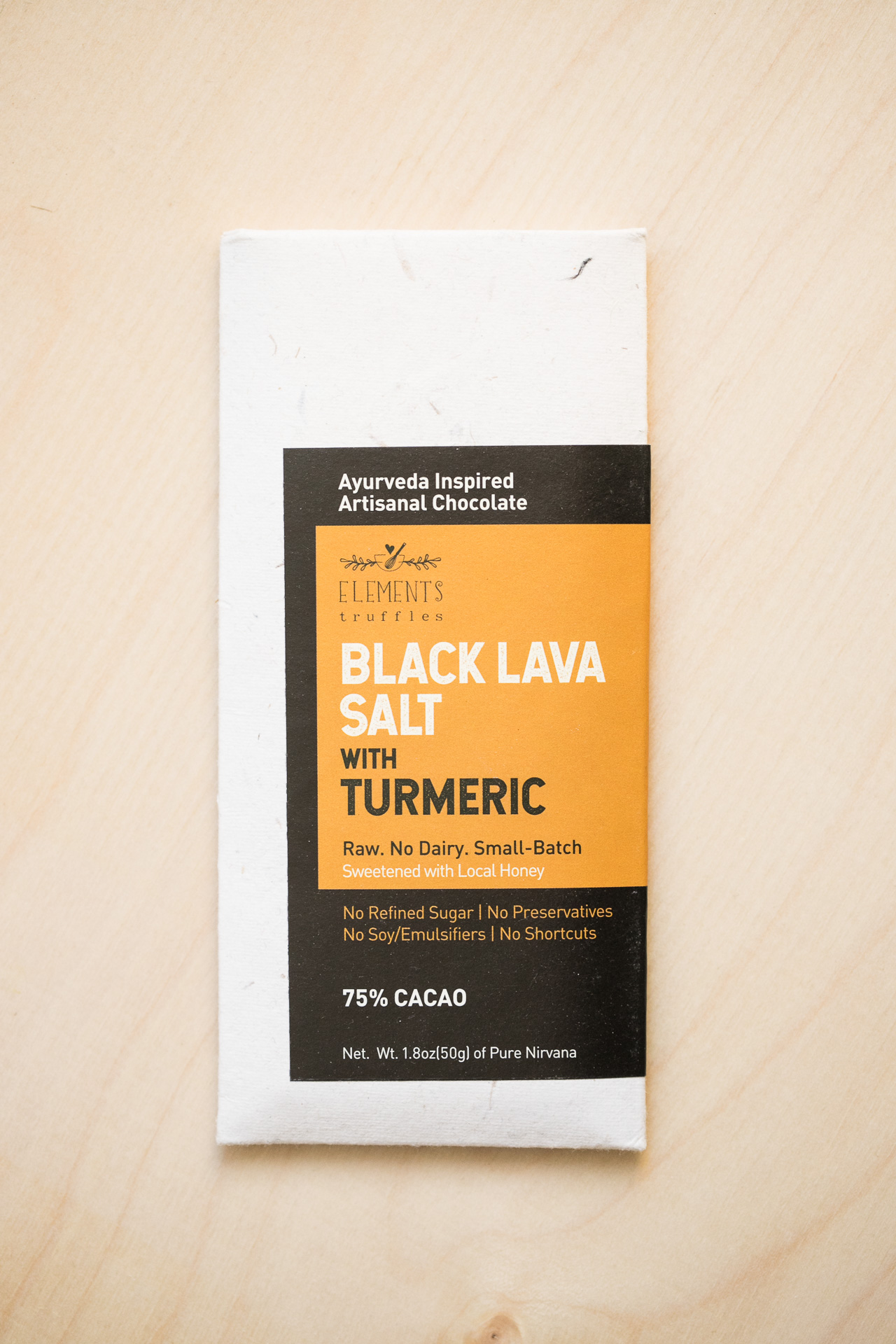
Chocolate Review: Element Truffles’ Black Lava Salt with Turmeric Chocolate Bar

Bar: Black Lava Salt with Turmeric
Maker: Elements Truffles
Chocolate Percentage: 75%
Price: $7/50g Bar
Ingredients: Organic Raw Cacao Paste, Raw Honey, Organic Raw Cacao Butter, Organic Turmeric Root Powder, Black Lava Salt, Himalayan Pink Salt
Additional Notes: Chocolate Origin: Ecuador

Packaging: “Ayurveda Inspired Artisanal Chocolate” makes me think this is a chocolate meant for yogis. Ayurveda, as explained by the back of the package, derives from Ayur (life) and Veda (knowledge), and it is a “sister science” to Yoga that focuses on inner and outer wellbeing through balancing elements in the body. So perhaps this is best enjoyed to further sweeten your yoga session?

Appearance: The chocolate consists of a full, unsectioned bar with a lotus flower design to the side, adding to the whole spiritual and meditation theme of this product.
Aroma: The bar has a slight caramel like scent to it. Perhaps it comes from the combination of the dark chocolate with the honey. I don’t get any incense aromas. I guess it’s not that spiritual.
Melt & Snap: There snap is hard, but the chocolate melts nice and slowly. The texture is a little more gritty than the others. Maybe it has to do with the rawness of the chocolate? Or is it a consequence of the turmeric powder? I wasn’t sure. However, the grittiness was not at all unpleasant or distracting. The melt was quite satisfying.
Flavor: There honey flavor definitely comes through pretty strongly bringing a distinct sweetness to this chocolate. It really helps lighten the bitterness I would’ve expected from a 75% dark chocolate. I still think I would’ve preferred a regular sugar based sweetener though. I’m not sure that I got a distinct turmeric taste from the chocolate. I’m not sure what turmeric tastes like on its own to be honest. Overall, not a bad chocolate, but not my favorite either.

Chocolate Review: Dick Taylor 73% Dark with Fleur de Sel | Northerner Blend

Bar: Dick Taylor 73% Dark with Fleur de Sel | Northerner Blend
Maker: Dick Taylor Craft Chocolate
Chocolate Percentage: 73%
Price: $9.50 per 57g / 2oz bar (online)
Ingredients: Cacao*, Cane Sugar*, Fleur de Sel (*Organic)
Additional Notes: Chocolate Origin: Northerner Blend – Brazil & Madagascar

Packaging: The main focus on the front of the packaging has a block print drawing of a sailboat with its crew on the flat deck navigating the vessel in the expansive ocean with some picturesque clouds. Dick Taylor’s company logo and the name of the bar take the blank space in the sky about the boat.

Compared to the other chocolate bars, the back of this packaging is relatively simple. Another mostly black and white etching shows two workers harvesting salt. There are a few more informational details, like the fact that the salt in the bar is hand-harvested Guatamala sea salt by Bitterman Salt Co., and that the chocolate was handcrafted using traditional European techniques in Humboldt County, California. There is even a batch no stamped on. However, you’d have to go to the website to learn that the chocolate is a blend of Brazilian and Madagascan cacao sweetened with Brazilian cane sugar. The website also gives additional details about “Northerner Blend”, which I guess is their name for this chocolate bar.

The chocolate is wrapped in a gold plastic with the signature Dick Taylor diamond and designs that are also etched into the surface of the chocolate itself. I’d say this inner packaging and the design of the bar itself are more exquisite than the two previous bars. The back of the chocolate bar is smooth and does not have the imprint design.

Appearance: The front of the bar had a nice dark brownish red color with some little splotches of brighter red tints. The back of the bar was a noticeably lighter shade of brown. It looked like it bloomed. You could also see the flecks of sea salt on the back of the chocolate bar.
Aroma: Nothing besides the chocolate and sea salt. It is a two ingredient bar after all.
Melt & Snap: The chocolate didn’t melt at all and had a hard snap. I even felt like I had to chew the chocolate to eat it.
Flavor: I was fairly disappointed by the lack of flavor in this chocolate, which was easily overpowered by the sea salt. Both the texture and the taste make leads me to believe that despite the Best Before date not passing yet, the chocolate had turned bad while in transport or something wasn’t processed correctly. Before writing off Dick Taylor chocolate, I would want to try a different bar.

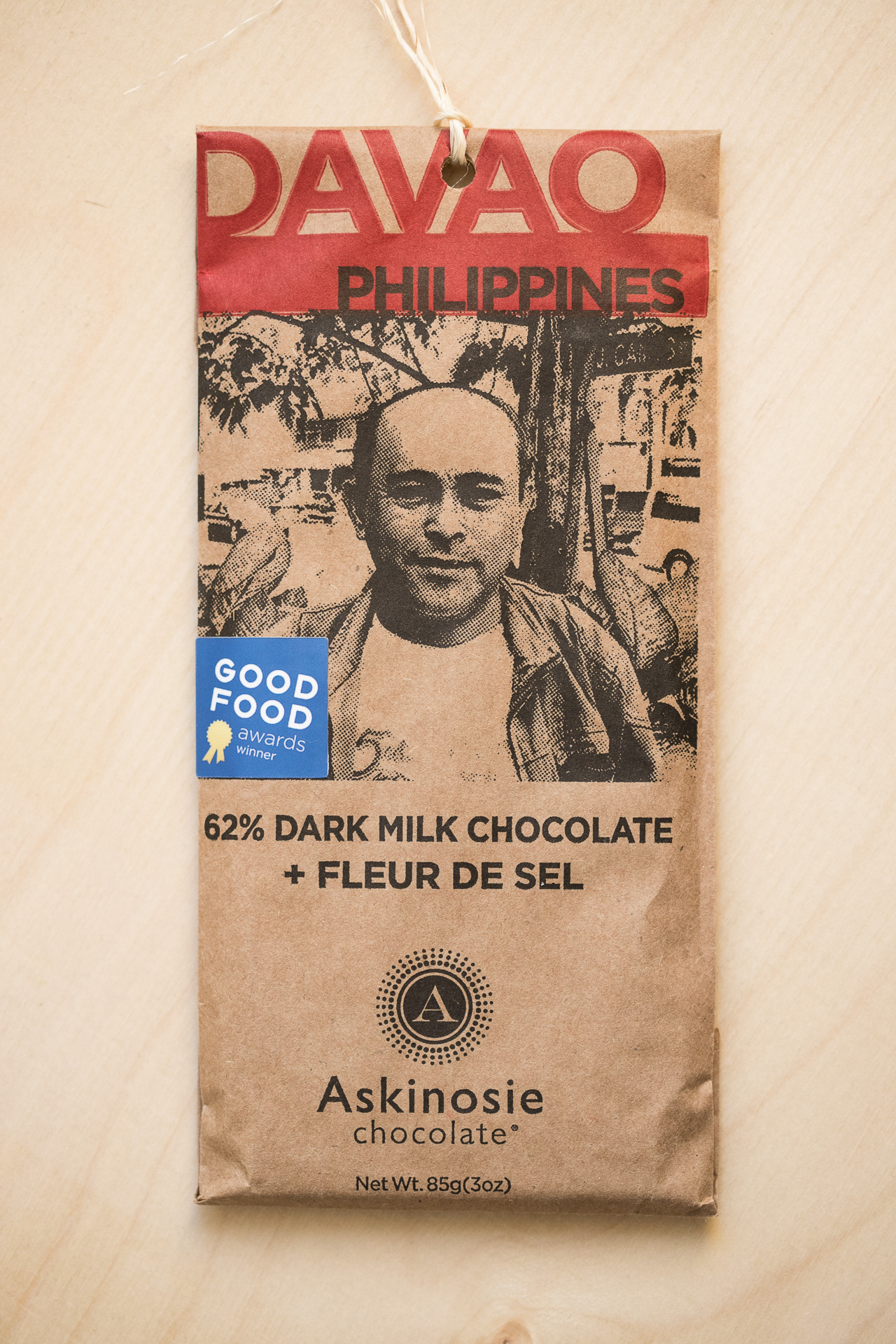
Chocolate Review: Askinosie 62% Dark Milk Chocolate + Fleur De Sel

Bar: 62% Dark Milk Chocolate + Fleur De Sel Sea Salt Bar
Maker: Askinosie (Springfield, MO, USA)
Chocolate Percentage: 62% dark milk chocolate (54% cocoa liquor and 8% cocoa butter)
Price: $8.95 / 85g (3oz) from The Basket Store at Chelsea Market; $8.50 online
Ingredients: Davao, Philippines Cocoa Beans (Trinitario), Organic Cane Sugar, Cocoa Butter (made in factory with Davao beans), Goat’s Milk Powder, Sea Salt (from The Meadow)
Additional Notes:
Chocolate Origin: Davao, Philippines
Awards: 2017 – Bronze – Academy of Chocolate Awards; 2016 – Americas – Silver International Chocolate Award; 2014 – Good Food Award; 2013 – Good Food Award; 2011 – Gold – London Academy of Chocolate’s Best Bean to Bar Milk Chocolate; 2011 – Silver – London Academy of Chocolate’s Best Bean to Bar Milk Chocolate; 2011 – Gold – London Academy of Chocolate’s Best Packaging

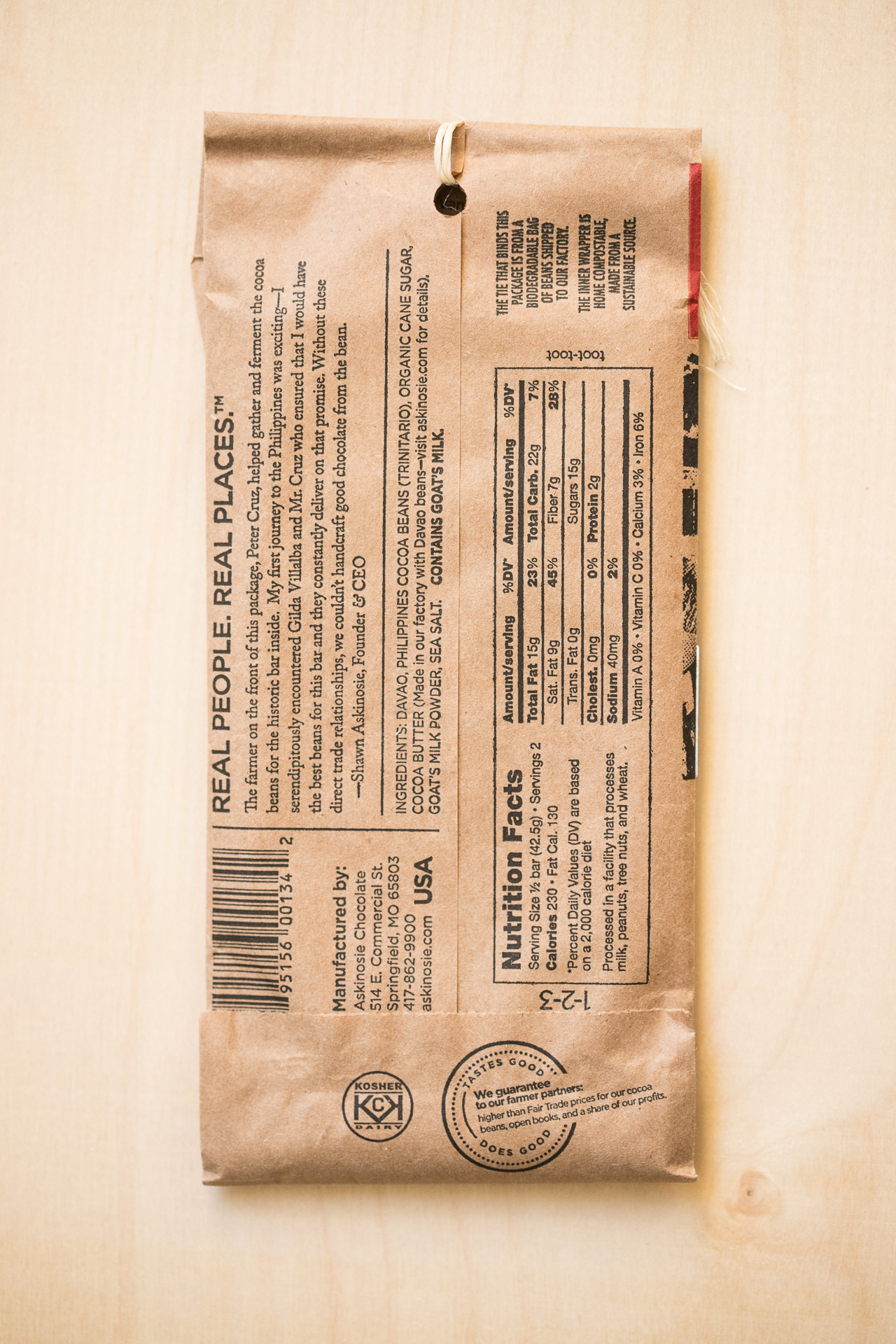
Packaging: And I thought the inside packaging of the Raaka chocolate bar was detailed. Askinosie takes it to another level in terms of transparency. The focus on the front of the packaging is on the source of the chocolate with “Davao Philippines” printed boldly at the top with a picture of the cocoa bean farmer below. The specific chocolate bar type and Askinosie brand logo are left to the lower third of the front label. The back of the packaging touts a “Real People. Real Places” trademark and explains that the farmer on the front of the package is Peter Cruz, whom Shawn Askinosie, Founder & CEO personally met on his first journey to the Philippines. Askinosie also promises a “Taste Good Does Good” approach to their chocolate by guaranteeing higher than Fair Trade prices to the farmers, open books, and a share of the company’s profits. However, an equitable supply chain does not seem to be the only company focus. The paper packaging even details that the tie keeping it closed came from a biodegradable bag of beans that were shipped to the factory. Further, the inner wrapper of the chocolate is also home compostable from and made from a sustainable source. Askinosie also values environmental sustainability in its production process. The last detail on the packaging is a rubber stamped number, which I would guess equates to some kind of batch number. However, a lot more detail about Davo, Philippines and Peter Cruz can be found on the company’s website. The details here include that the cocoa bean consists of a Trinitario variety, which are harvested in October-November, fermented in wooden boxes, sun dried on a patio under rain cover. The chocolate comprises of 54% cocoa liquor and 9% cocoa butter, has a medium roast, medium conch and is tempered at 43C, 31.6C. Again, the level of transparency is shocking.

Appearance: The chocolate bar is divided into a 6×3 rectangle grid, with a letter centered on each square to spell out “Askinosie Chcocolate”. Not the prettiest bar in my opinion, but it does get a proud message across. Being a dark milk chocolate, the color is lighter than your typical dark chocolate bar. The chocolate has a nice little shine to its surface.
Aroma: Creamy vanilla and caramel smells
Melt & Snap: Crisp snap. Ultra smooth, creamy, slow melt. No hint of grittiness in the chocolate (like Raaka).
Flavor: A sweeter dark chocolate, with vanilla and milky caramel tones. Definitely get the luxuriousness from the goat’s milk. I did not taste much of the sea salt, but got a hint of toasted nuts instead. This is a far cry from Hershey’s.

Chocolate Review: Raaka Bourbon Cask Aged Chocolate

Bar: Bourbon Cask Aged Unroasted Dark Chocolate
Maker: Raaka Chocolate (Brookyln, NY, USA)
Chocolate Percentage: 82%
Price: $5 / 1.8oz Bar (sale at Whole Foods)
Ingredients: Organic cacao beans, organic cane sugar, organic maple sugar, organic cacao butter
Additional Notes: Chocolate Origin: Kokoa Kamili, Tanzania Awards: 2013 Good Food Award Winner

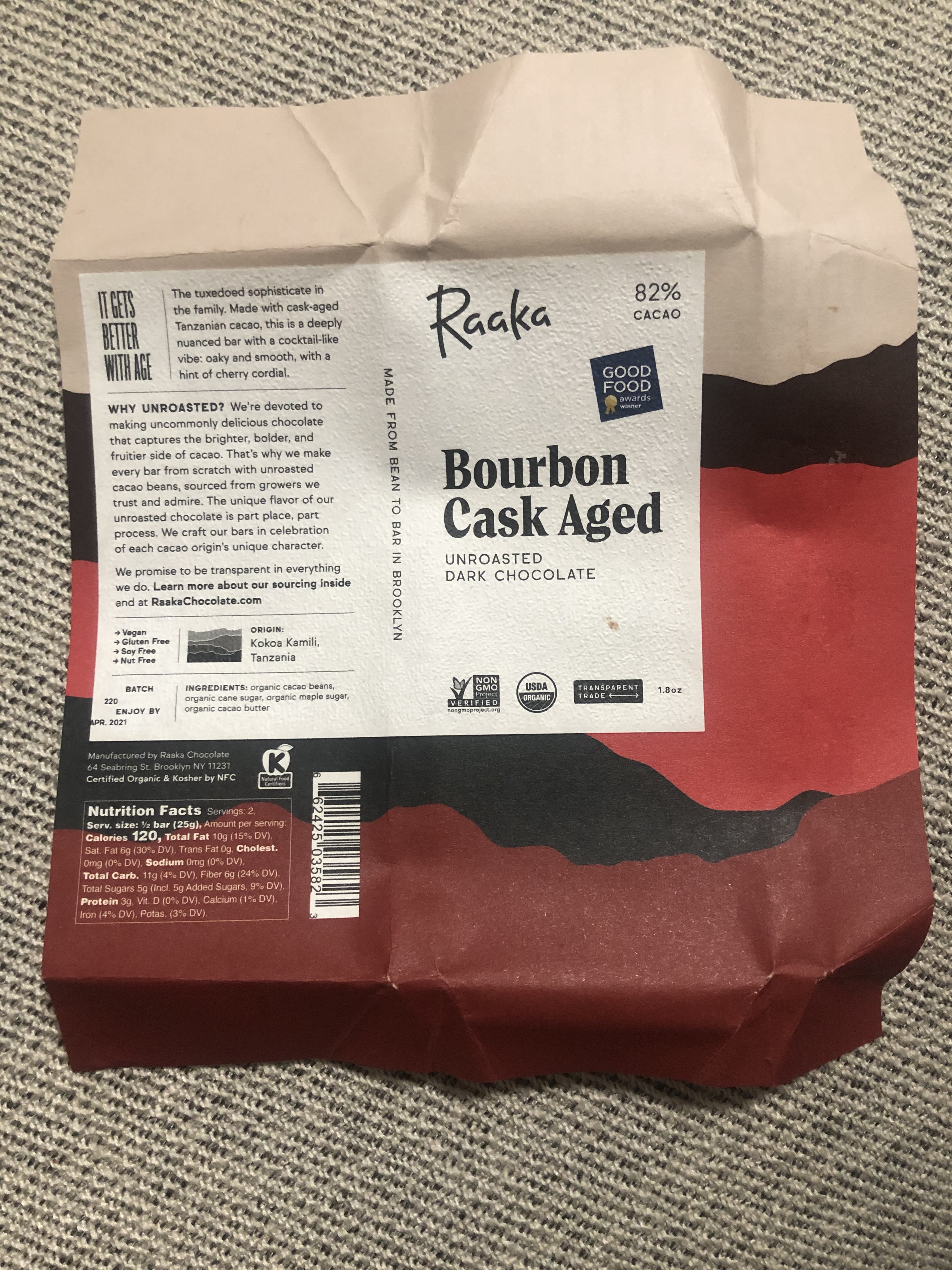
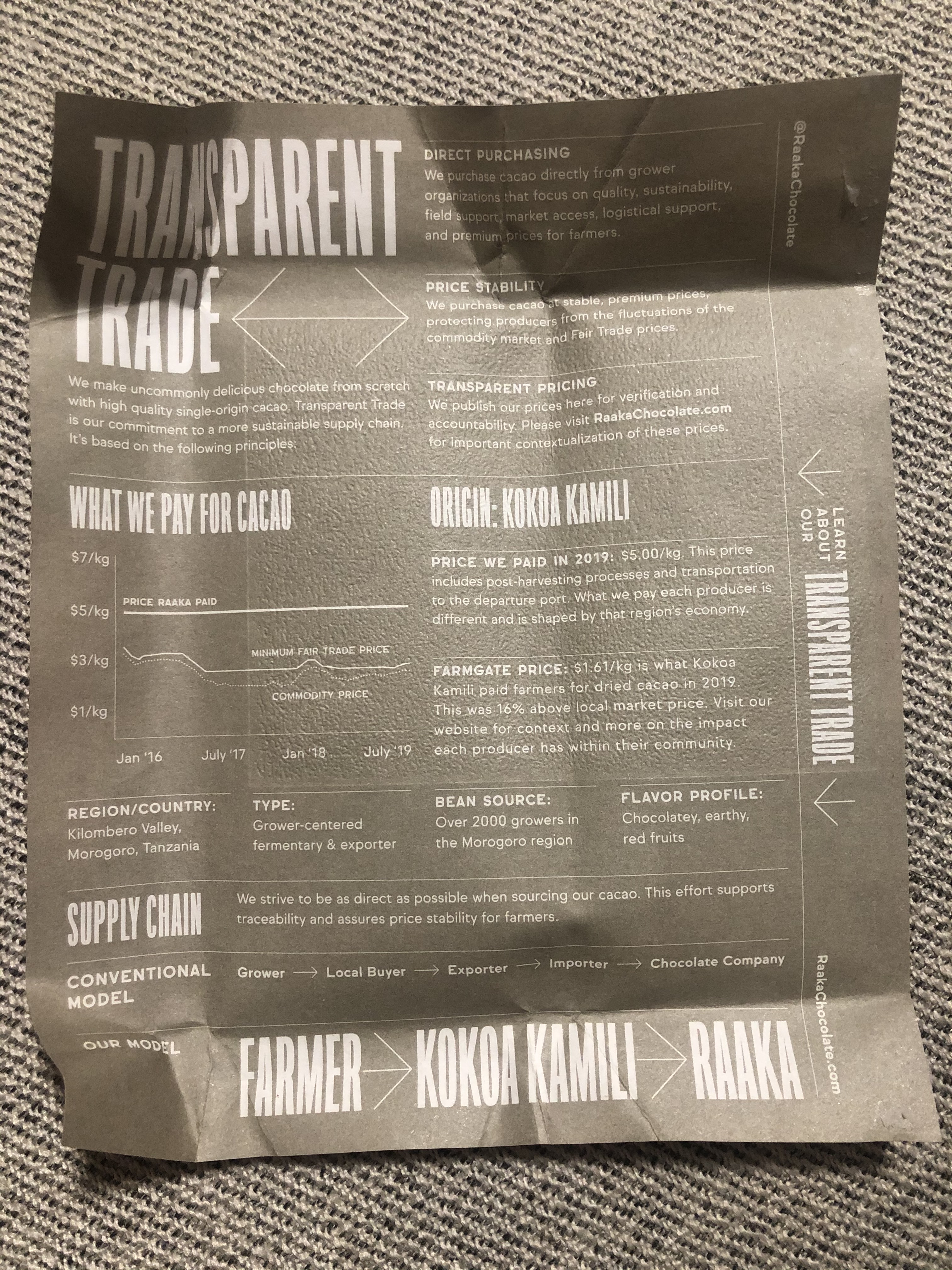
Packaging: Textured paper with an abstract print of pink, brown, red and cherry on the outside. My wrapper noted this bar was part of Batch 220. On the inside of the packaging, Raaka outlines what they mean by “Transparent Trade“, which includes details on the region/country of the cacao used to produce this chocolate (Kokoa Kamili, Tanzania) , the type of sourcing (grower-centered fermentary & exporter in this instance), and prices paid. It is the most detail I have seen thus far on the wrapping of a chocolate bar. The bar itself is wrapped within another piece of paper, with one-sided silver foiling.

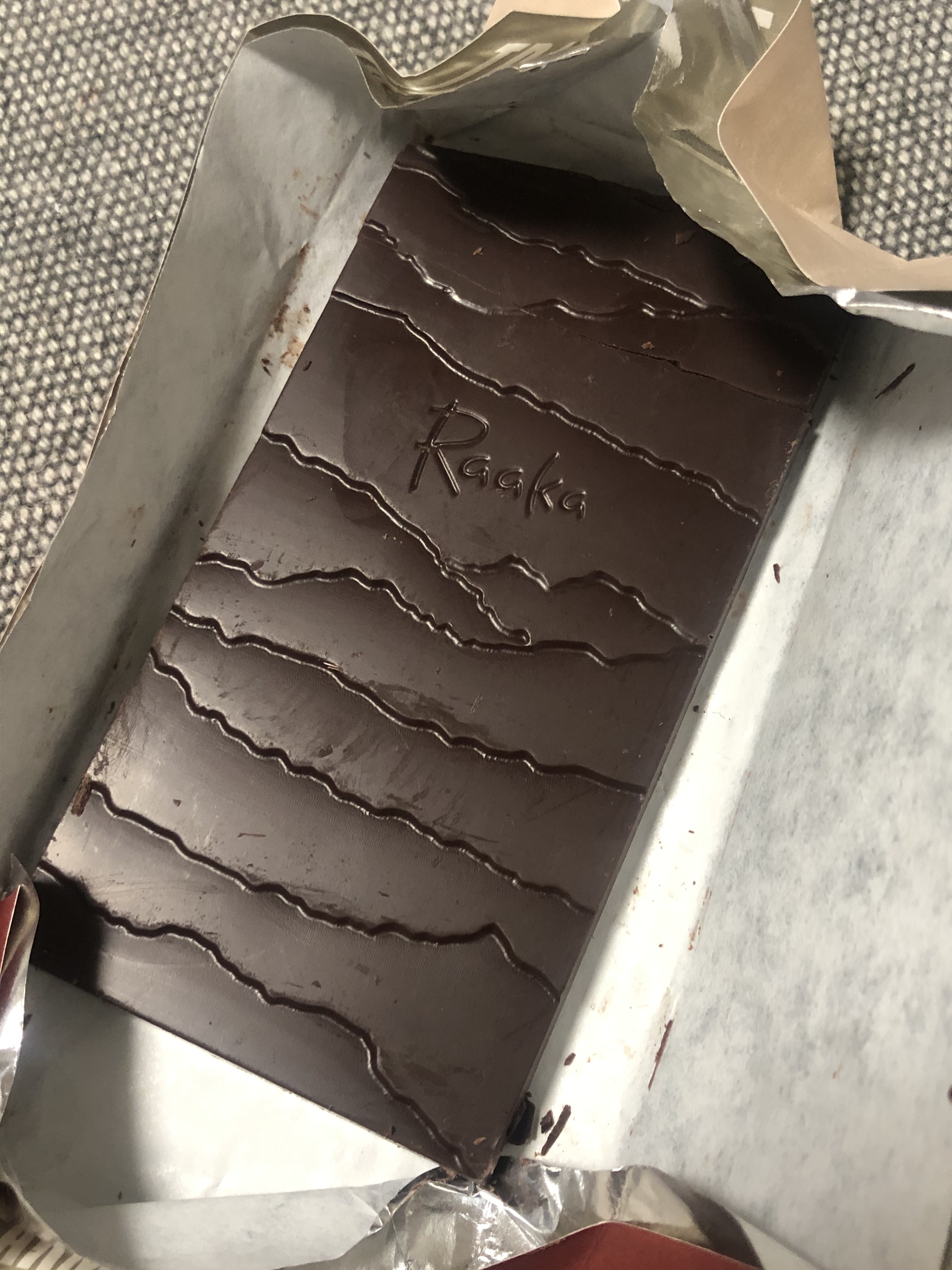
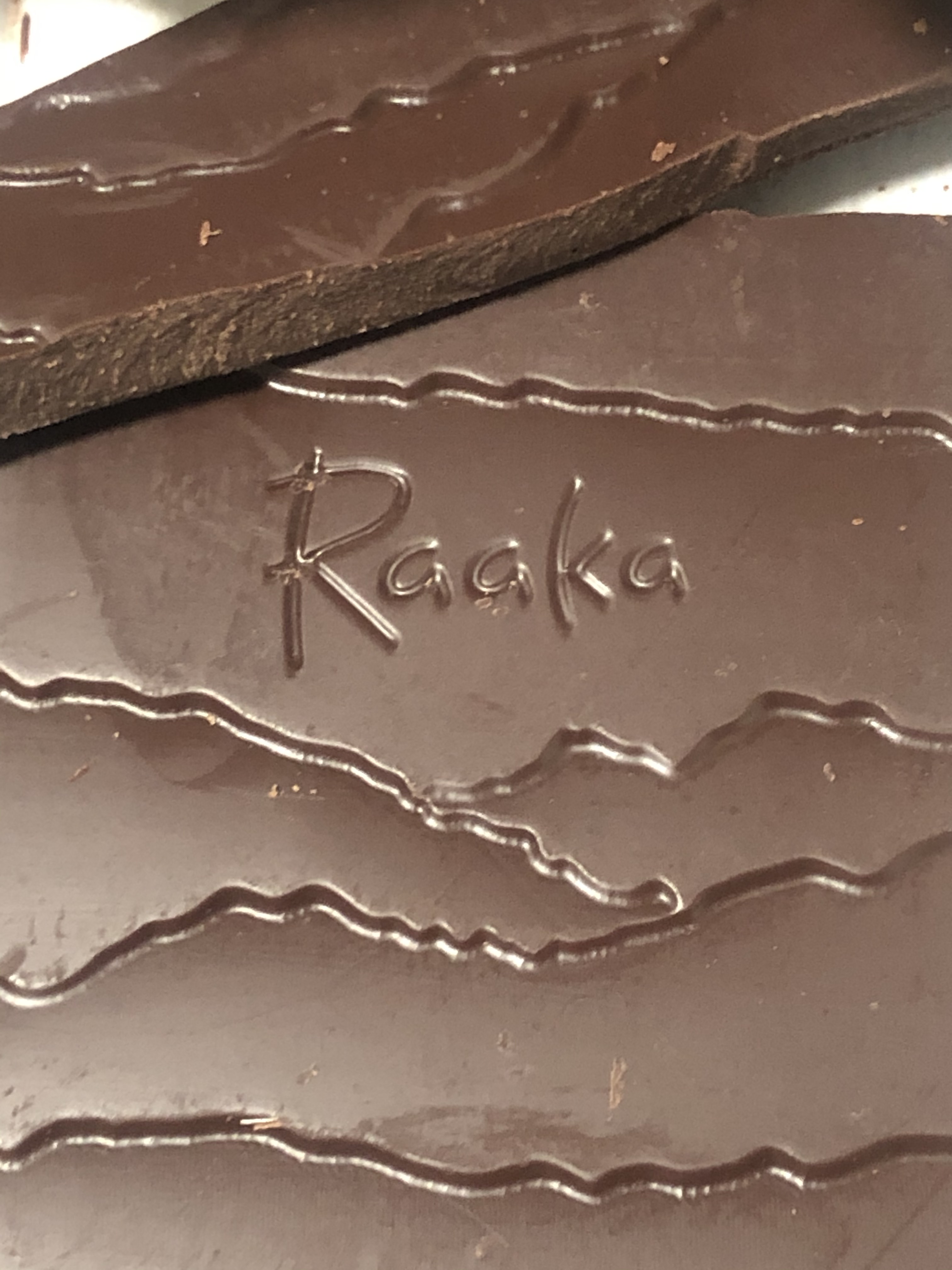
Appearance: Solid rectangular bar with layers of horizontal ridge lines on the front and an imprinted logo in the upper-center of the bar. The lines evoke the sense of overlapping mountain ranges or waves.
Aroma: Sharp, bright, cherry notes but with earthy undertones
Melt & Snap: gentle snap, smooth and slow melt
Flavor: Admittedly, this bar was the first in my foray of trying artisan craft, bean-to-bar chocolate, and I probably started with a fairly complex one given the advertised flavor profile. The chocolate is bitter at 82% but still packs a surprisingly bright taste that reminded me of cherries and goji berries. Given the slow, smooth melt, undertones of the oak also shine their way through. The chocolate even has a very slight gritty, velvety texture to it, which seems to play to the “tuxedoed sophisticate” superlative Raaka has given this chocolate of theirs. I wonder if the mouth feel has to do with the fact that these beans were “unroasted”, which is Raaka’s unique processing method. The complexity of this chocolate has made me feel compelled to have two tastings on each occasion of enjoyment.