Interesting Pieces (1/15/2022)

Here are a couple of articles, podcasts and videos I liked this week. I’ve also been enjoying listening to The Cartiers by Francesca Cartier Brickell.

Articles

  • Why You Should Ignore the Metagame – In every game there are always two games being played. One is the game itself. The other is the game about the game. This is called the metagame. … Every game has an underlying metagame. But, unless you are prepared to become obsessed with that metagame, I recommend that you ignore it altogether. In other words, go all out or don’t waste your time. Those are your only two options. (ofdollarsanddata)
  • Gurus and Pickleball – … This is consistent with the most interesting idea that I’ve ever encountered: that your “subtle” attention and your interests would drive your personal growth, but via an unpredictable route. (theattentionspan)
  • Gurus and Pickleball linked to Dan Wang‘s annual letters:
    • 2021 Letter – The Chinese growth story is not simply produced by the government or by entrepreneurs. It is a heterogenous entity where different regions dialectically engage to obstruct and improve each other.
    • 2020 Letter – As economic growth [in China] slows down, the country is doubling down on centralized government. Over the last several years, the state is taking more of a leading role in the economy. … The creation and repetition of key slogans isn’t just crowding out the room for other ideas. The state has prosecuted a decade-long effort to suppress the views it doesn’t like. Not only has the government ramped up censorship, society as a whole is developing greater intolerance for dissenting ideas. … It might not be clear that censoriousness is hurting the creation of new companies, but it is clear that it’s becoming more difficult to create better cultural products.
  • Does Not Compute – A lot of things don’t make any sense. The numbers don’t add up, the explanations are full of holes. And yet they keep happening – people making crazy decisions, reacting in bizarre ways. Over and over. (collaborativefund | Morgan Housel)

Podcasts

Videos

The Happiness Advantage

The Happiness Advantage (The Seven Principles of Positive Psychology That Fuel Success and Performance at Work) by Shawn Achor, 9780307591548

Happiness comes after you’ve reached your goals. You’ll be happy once you’ve achieved success. Right? Apparently not!

Positive psychology – a relatively new field started in 1998 by psychologist Martin Seligman – has turned that common idea inside out. Happiness leads to success. Research has shown that optimism, makes us more motivated, efficient, resilient, creative, and productive, which fuels performance and achievement.

In The Happiness Advantage, author Shawn Achor shows us the many ways happiness leads to positive outcomes and gives us practical principles to actively cultivate optimism. He gives us hope that – with some effort – we can rewire our brains to change our outlook, and set ourselves up to reap the multiple benefits of happiness.

Just reading this book has given me a good dose of optimism. After growing up thinking that I had to struggle and grind away to reach happiness through (eventual but still uncertain) success, I now feel like there is a different path. Equipped with Achor’s principles and the research and lessons he shares, I can change my approach to life for a better outlook.

But there’s more. Achor goes on to show that by becoming happier and more optimistic myself, I could have a positive impact on the people around me. He calls this the “ripple effect.” As someone who is naturally more anxious worry wart, I now know to make a more conscious effort to be a “happier” person for the benefit of my friends, family, coworkers, and the greater community.

I don’t think these are just hippy-dippy words of advice. I am making a conscious effort to put Achor’s principles into action. I’ve started a daily gratitude practice and will try to foster deeper connections with people in my everyday interactions. I’m excited to see where these new habits may lead.

Click below to see my notes on the seven principles presented in The Happiness Advantage.

Continue reading

Trillion Dollar Coach

To build a successful company in today’s day and age, you need to employ smart creatives and construct teams that are “individually and collectively obsessed with what’s good for the company.” In turn, these high-performing teams require a great leader who is both a strong manager and a caring coach. Trillion Dollar Coach dives into the responsibilities of the ultimate coach, as inspired by Bill Campbell. Campbell coached Eric Schmidt and Jonathan Rosenberg (two of the book’s authors), Sundar Pichai and Ruth Porat, Steve Jobs, Jeff Bezos, Jack Dorsey, Sheryl Sandberg, and countless others. He is the “trillion dollar coach.”

Trillion Dollar Coach has four chapters with numerous governing leadership / coaching principles in each: 1) Your Title Makes You Manager. Your People Make You a Leader, 2) Build an Envelope of Trust, 3) Team First, and 4) The Power of Love. The following are my notes and take aways regrouped into the overarching themes I saw.

Picking the Right Players

  • The top characteristics to look for are smarts and hearts: the ability to learn fast, a willingness to work hard, integrity, grit, empathy, and a team-first attitude.
  • A big turnoff for Bill was if they were no longer learning.
  • People who show up, work hard, and have an impact every day. Doers. “It’s not what you used to do, it’s not what you think, it’s what you do every day.”
  • People who put team first. As Sundar Pichai says, “people who understand that their success depends on working well together, that there’s give-and-take — people who put the company first.”
  • Bill valued courage: the willingness to take risks and the willingness to stand up for what’s right for the team, which may entail taking a personal risk.

Taking Care of the People

  • It’s the People Manifesto:
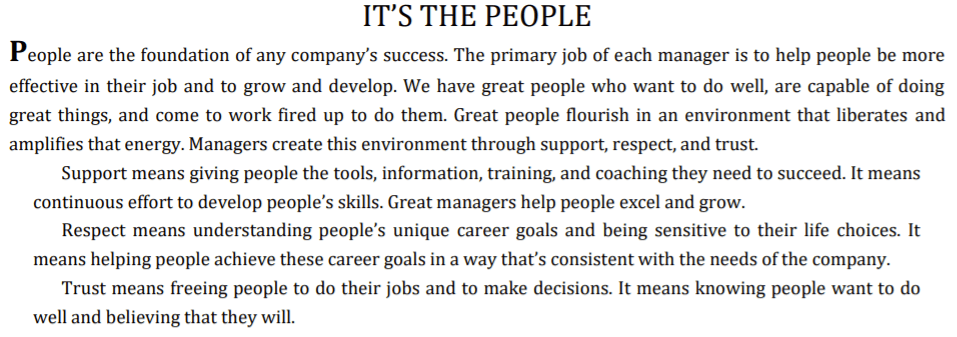
  • The top priority of any manager is the well-being and success of her people.
  • Most people don’t spend a lot of time thinking about how they are going to make someone else better. But that’s what coaches do.
    • “Think that everyone who works for you is like your kids,” Bill once said. “Help them course correct, make them better.”
    • Be relentlessly honest and candid, couple negative feedback with caring, give feedback as soon as possible, and if the feedback is negative, deliver it privately.
  • Trust is the first thing to create if you want a relationship to be successful.
    • Trust means people feel safe to vulnerable (psychological safety – one of the five factors of successful teams). Trust means you keep your word. Trust mean loyalty. Integrity. It means ability, the trust that you actually had the talent, skills, power, and diligence to accomplish what you promised. Trust means discretion.
    • People are most effective when they can be completely themselves and bring their full identity to work
  • Believe in people more than they believe in themselves, and push them to be more courageous.

Building the Team & Community

  • Bill believed in striving for the best idea, not consensus. The goal of consensus leads to “groupthink” and inferior decisions. To avoid groupthink:
    • Make sure that people have the opportunity to provide their authentic opinions, especially if they are dissenting.
    • Help people prepare for group meetings. Have them think through and talk through their own perspective so they are ready to present it.
    • Create an environment that is “safe for interpersonal risk taking … a teams climate … in which people are comfortable being themselves.”
  • Winning depends on having the best team, and the best teams have more women.
  • Bill thought peer relations were more important than relationships with your manager or other higher-ups. What do your teammates think of you? That’s what’s important!
    • Seek opportunities to pair people up on projects or decisions. It will build a deeper sense of understanding between different team members.
    • To build rapport and better relationships among team members, start team meetings with trip reports, or other types of more personal, non-business topics. The simple communication practice – getting people to share stories, to be personal with each other – was in fact a tactic to ensure better decision making and camaraderie.
  • Most important issues cut across functions, but, more important, bringing them to the table in team meetings lets people understand what is going on in the other teams, and discussing them as a group helps develop understanding and build cross-functional strength.
  • “Knowledge commonality” helps the team perform better and is well worth the time it requires.
  • Getting to the right answer is important, but having the whole team get there is just as important.
    • When two people disagree, have them figure it out together. It empowers the people working on the issue to figure out ways to solve the problem, a fundamental principle of successful mediation. And it forms a habit of working together to resolve conflict that pays off with better camaraderie and decision making for years afterword.
    • Bill encouraged ensembles and always strived for a politics-free environment.
  • Listen, observe, and fill the communication and understanding gaps between people.

Leadership and Decision Making

  • When faced with a problem or opportunity, the first step is to ensure the right team is in place and working on it.
  • Define the “first principles” for the situation, the immutable truths that are the foundation for the company or product, and help guide the decision from those principles.
  • Identify the biggest problem, the “elephant in the room,” bring it front and center, and tackle it first.
  • Failure to make a decision can be as damaging as a wrong decision. Having a well-run process to get to a decision is just as important as the decision itself, because it gives the team confidence and keeps everyone moving.
  • The manager’s job is to run a decision-making process that ensures all perspectives get heard and considered, and, if necessary, to break ties and make the decision.
  • When things are going bad, teams are looking for even more loyalty, commitment, and decisiveness from their leaders.
  • Stay relentlessly positive. Positive leadership makes it easier to solve problems. Also be relentless in identifying and addressing problems. Stick to “problem-focused coping” in contrast to “emotion-focused coping”.
  • Strive to win, but always win right, with commitment, teamwork, and integrity. Remember “the humanity of winning” by which he means winning as a team (not as individuals) and winning ethically.
  • Harness the power of love:
    • Be generous with your time, connections, and other resources.
    • To care about people you have to care about people: ask about their lives outside of work, understand their families, and when things get rough, show up.
    • Cheer demonstrably for people and their successes.

From these principles, it is clear that Adam Grant writes in the book’s forward is true. Trillion Dollar Coach belongs in the help-others section. “It’s a guide for bringing out the best in others, for being simultaneously supportive and challenging, and for giving more than lip service to the notion of putting people first.”

I had heard of Bill Campbell previously as a Columbia student-athlete. After graduating from Columbia University, he was an influential football coach from 1974 to 1979 and went on to become a trustee. The sports center at Baker Athletics Complex is named after him. After his passing in 2016, he was honored by the school in numerous ways for his leadership and generosity. I didn’t realize the scope of his positive influence on people until after reading this book. I feel inspired to try to live by some of these principles and follow his example to create a beneficial impact on my teams and in my community.

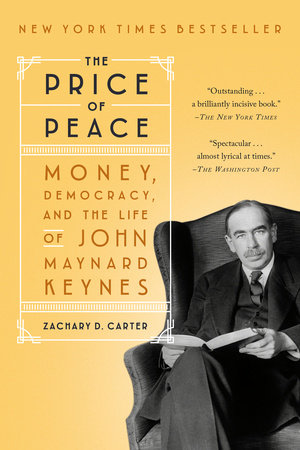
The Price of Peace by Zachary D. Carter Notes

The Price of Peace by Zachary D. Carter

In The Price of Peace author Zachary D. Carter tells the story of John Maynard Keynes’ career, his significant contributions to world politics during both World Wars and The Great Depression, and his lasting impact on political and economic theory.

From early on, Keynes held the view that money was inherently a political part of society. As laid out in the first chapter of his A Treatise on Money, “To-day all civilised money is, beyond the possibility of dispute, chartalist.” The social nature of markets puts them at the mercy of (irrational) people trying to navigate an unknown future. Unexpected events, changing attitudes, flawed assumptions, and general uncertainty can prevent “free markets” from naturally self-correcting to equilibrium without potentially catastrophic instability. Economics could not be fully distilled into a hard science of mathematical proofs like physics. Given these shortcomings, Keynes believed governments needed to have the authority to structure, guide and – at times – manage markets in order to maintain “order, legitimacy, and confidence.”

This led to a big clash of ideals and of titans, pitting John Maynard Keynes and his “Keynesian” economics against Friedrich von Hayek, who pushed laissez-faire capitalism and neoliberalism. Hayek believed the world needed an upper class to transmit knowledge and define society’s values through the generations. After living through the Weimar Republic’s period of hyperinflation, what mattered to Hayek was “the rights of an aristocracy against the central government.” Keynes rejected Hayek’s ideas. To him, laissez-faire had led to vast inequality and social unrest.

In the post World War era, Paul Samuelson and Milton Friedman would also advocate for free-markets and try to fit economics into more of a pure science. For Samuelson, rational, profit-maximizing behavior would naturally lead to the supply-demand equilibriums of David Ricardo and Adam Smith. Meanwhile, Friedman believed “nothing could stand in the way of hard work and good ideas … there was no problem the market could not solve – even war.” True individual freedom came from man’s ability to participate in the market. During the Bill Clinton administration, these idealistic views of free markets, free trade, and globalization led to sweeping social changes. Clinton’s policies included government deregulation and the establishment of North American Free Trade Agreement (NAFTA) and the World Trade Organization (WTO). America did enjoy a brief period of unmatched prosperity, but income equality exploded in the 1990’s and the untethered financial markets eventually collapsed in the Great Recession.

As Carter writes, “The chief policy prescription of neoliberalism – let financial markets organize the distribution of resources and capital – had failed very publicly. Financial markets were obviously not rational – banks had blown themselves up – nor could they claim to offer a predictable, stable route to prosperity. The crash-induced recession had caused mass suffering.”

In contrast to laissez-faire and neoliberalism, Keynes argued for greater governmental authority in the economy to preserve social stability and prosperity. After World War I, he was against German reparations, predicting that the austerity measures required to make the debt repayments would breed resentment and social unrest (aka the rise of Hitler and World War II). In fact, he would become a lifelong enemy of austerity and, on the flip side, advocate for large government spending (investment) after deep recessions. Keynesian economic philosophy is most embodied by President Franklin D. Roosevelt’s New Deal, President Lyndon B. Johnson’s Great Society, and potentially President Joe Biden’s Infrastructure Bill. By alleviating poverty and bringing economic freedom, the government – Keynes believed – could produce a supportive society to ensure a “good life” for all (and not just Hayek’s aristocrats).

“[Keynes’] rubric for determining economic success or failure was not growth or productivity by “greatness”. There was objective aesthetic cultural achievements – Shakespeare – that economic policy was supposed to support.”

The Price of Peace, Zachary D. Carter

Keynesianism (which is John Maynard Keynes’ broader political philosophy vs. Keynesian which is mostly focused on economics?), Carter concludes, is “not so much a school of economic thought as a spirit of radical optimism”. It is a hopeful belief that with the right political leadership and steadying economic management, a democratic government could alleviate inequality, enable “artistic flowerings” (the Bloomsbury life), and encourage shared prosperity.

As further detailed in The Price of Peace, John Maynard Keynes did not live an easy life since his ideas were frequently “ahead of his time”. Nevertheless, he was courageous and pushed on until his death. I learned a lot about – and from – him while reading Carter’s book. The Price of Peace also also taught me more history, political theory and even some philosophy. While long (at over 650 pages), I did appreciate this read overall. It is obvious that Carter put a lot of work in bringing all of the ideas and concepts together. And I come away from it curious to learn more.

Some Guidance on Public Speaking

Driven by the goal of improving my public speaking and negotiating skills, I recently dove into three books: How to Win Friends and Influence People, Quiet and Talk Like Ted. While written for slightly different purposes, these texts had a few, core overlapping ideas I found instructive.

Impressions matter

Body language, charisma, and confidence all influence the impressions we impart on other people. And, while it may be unfair at times, first impressions and people’s perceptions of us can greatly affect our future success. Positive and charismatic leaders, aka “extroverts”, who can lead discussions, make presentations, and engage dynamically in conversations, appear more intelligent and more authoritative. This gives them more power and increases the likelihood they will be taken seriously and that their suggestions will be put into action.

In Quiet, Susan Cain writes, “We perceive talkers as smarter than quiet types. We also see talkers as leaders. The more a person talks, the more other group members direct their attention to him, which means that he becomes increasingly powerful as a meeting goes on. It also helps to speak fast; we rate quick talkers as more capable and appealing than slow talkers.”

What is particularly important here, is that the enthusiastic leader lifts the moods of others through his/her positivity. Positive emotions are contagious and help rally support. As Carmine Gallo says in Talk Like Ted, “Charismatic leadership is linked to organizational success because charismatic leaders enable their followers to experience positive emotions.”

Interestingly, in many cases, it doesn’t matter if these leaders are right. They are the people who are remembered and whose instructions are followed when the meeting is adjourned. This means that if you want your ideas to be taken seriously, you have to deliver them convincingly, with confidence and positivity. (But of course it also helps to be right.)

But what if confidence and charisma do not come naturally to you? That brings us to the next core idea.

Use physical behavior to guide your emotions and build up confidence and charisma

In Talk like Ted, Amy Cuddy, a social psychologist at HBS, says, “Our bodies change our minds, and our minds can change our behavior, and our behavior can change our outcomes.”

Perhaps the most important behavior touted in both How to Win Friends and Influence People and Quiet is smiling. In fact, in How to Win Friends and Influence People, Dale Carnegie lists the simple smile as the second principle in his six ways to make people like you. Smiling (our body) helps create a positive internal attitude (our mind) that is reflected in our actions (our behavior). And in Quiet, Susan Cain connects those behaviors to Cuddy’s outcomes. She writes, “We must smile so that our interlocutors will smile upon us. Taking these steps will make us feel good – and the better we feel, the better we can sell ourselves.”

Carmine Gallo would add that having “command presence” – the look of authority – could also instill confidence in ourselves and attract followers. He writes in Talk like Ted, “How we use our bodies – our nonverbal cues – can change people’s perceptions of us. Simply changing your body position affects how you feel about yourself and, by default, how others see you. Even if you don’t feel confident, act like it and your chances of success greatly improve.”

So, as the saying goes, “fake it until you make it.” Smile and take on strong body language to trick yourself into being more confident and charismatic. This will at least get you part of the way there … Like any other skill you’re looking to acquire, true mastery will only come with practice, which is the next main idea.

Public speaking takes practice

Even if you feel like you are not a natural extrovert or public speaker, there is still hope. In Quiet, Susan Cain says that according to Free Trait Theory, we may be born and culturally endowed with certain personality traits, but we can act out of character. An introvert can still rise up to be an inspiring public speaker. It just takes practice.

Deliberate practice strengthens the “muscles” associated with any skill, and, with public speaking in particular, it seems that practice can bring about actual structural brain changes that makes it easier over time.

As Gallo writes in Talk like Ted, “The brain areas involved in language – the areas that help you talk and explain ideas more clearly – these brain areas become more activated and more efficient the more they are used. The more you speak in public, the more the actual structure of the brain changes. If you speak a lot in public, language areas of the brain become more developed.”

Having more opportunities to practice public speaking also increases exposure to any potential fears. Over time, that fear will become desensitized, making future public speaking occasions easier to handle. In How to Win Friends and Influence People, Dale Carnegie also highlighted that “learning is an active process,” and that “we learn by doing.” As he writes, “You are attempting a new way of life. That will require time and persistence and daily application.”

Practice is hard. Being patient to persist over time is also hard, especially if it involves overcoming your fears. You need passion to help you see it through. That is the last idea.

Being a convincing and inspirational public speaker requires passion

As mentioned before, with Free Trait Theory, even introverts can take on the characteristics of extroverts and become inspiring public speakers. However, acting out of character in such a way, as Cain says, is usually in the service of a “core personal projects.” In other words, you have to be passionate about what you’re speaking about. By pursuing the activity for its own sake, and not for the rewards it may bring, you can reach a “flow” state that will make the effort of practicing and persisting easier to bear.

Passion will also make you more convincing. As Carmine Gallo writes in Talk like Ted, “Science shows that passion is contagious. You cannot inspire others unless you are inspired yourself. You stand a greater chance of persuading and inspiring your listeners if you express an enthusiastic, passionate, and meaningful connection to your topic.” I guess this should not be too surprising – that at the bottom of it all passion is the driving force that can help make any person a better public speaker. After all, passion is an essential underlying motivating factor.

In the end, I did find these three texts fairly helpful. As someone who is more introverted, or feels very self-conscious of how I will be judged for what I say, I now acknowledge that I have to take extra time to practice public speaking, voicing my thoughts, and hearing the sound of my own voice. I will try to adopt the technique of forcing a smile and embodying a commanding presence to instill a more positive, confident attitude. The greatest comfort reading these books gave me is confirmation that I can get better at this skill, and, that over time, it will become less scary. I do have the passion to take on this challenge.

Top Books of 2020

In the midst of this tumultuous year, and in large part due to the quarantine and work from home measures in effect since March, I found that I was able to read (skim and listen on audio) a lot more content in 2020. 

These are all the books I “read” (in roughly chronological order) with the ones I would recommend in bold and starred: 

  1. The Four Agreements by Don Miguel Ruiz
  2. Think and Grow Rich by Napoleon Hill
  3. Range by David Epstein*
  4. So Good They Can’t Ignore You by Cal Newport
  5. Alexander Hamilton by Ron Chernow (audiobook)*
  6. Navigating Debt Crises by Ray Dalio
  7. Too Big to Fail by Andrew Ross Sorkin*
  8. How Will You Measure Your Life by Clayton Christensen*
  9. Blood, Bones & Butter by Gabrielle Hamilton (audiobook)*
  10. The 80/20 Principle by Richard Koch***
  11. Show Your Work by Austin Kleon
  12. Make Time by Jake Knapp and John Zeratsky
  13. The Brain Fog Fix by Dr. Mike Dow (audiobook) 
  14. The Bhagavad Gita
  15. How to Take Smart Notes by Sonke Ahrens
  16. The Overstory by Richard Powers
  17. Sources of Power by Gary Klein  
  18. Deep Survival by Laurence Gonzalez 
  19. Ride of a Lifetime by Bob Iger***
  20. Drive: The Surprising Truth About What Motivates Us by Daniel H. Pink
  21. The Four Hour Work Week by Tim Ferriss 
  22. Between the World and Me by Ta-Nehisi Coates***
  23. Surely You’re Joking, Mr. Feynman! by Richard P. Feynman (audiobook)***
  24. Good Strategy Bad Strategy by Richard Rumelt
  25. Bean-to-bar Chocolate: America’s Craft Chocolate Revolution: The Origins, the Markers, the Mind-Blowing Flavors by Megan Giller
  26. Making Chocolate: From Bean to Bar to S’More by Todd Masonis, Greg D’Alesandre, Lisa Vega & Molly Gore
  27. The War of Art by Steven Pressfield
  28. Do the Work by Steven Pressfield
  29. The Psychology of Money by Morgan Housel
  30. The Foundation by Iaac Asimov
  31. Rich Dad Poor Dad by Robert T. Kiyosaki
  32. How to Win Friends and Influence People by Dale Carnegie
  33. Quiet by Susan Cain

My reading this year leaned heavily on the side of nonfiction (as usual) and can be further broken down into the following categories: 

  • Self-Help Books. Yes, I was definitely a sucker for these books this year. A lot of them were recommended as “life-changing” reads through numerous YouTube channels (another pastime I picked up while in quarantine). Some of them even seem to fall into a new “classics for productivity / self-starter gurus” kind of category. These would include Think and Grow Rich, The Four Hour Work Week, The War of Art, Do the Work, Rich Dad Poor Dad and How to Win Friends and Influence People. Show Your Work by Austin Kleon (and recommended by Ali Abdaal) is probably lesser known but has inspired me to bring new life to this blog. Overall, I’d say sure, these are good books to read  skim once if you feel inspired to do so, but, if you don’t, you’re probably not missing much. 
  • Finance and Business Books. Navigating Debt Crises and Too Big To Fail were reads inspired by the shutdown of the economy and my desire to review the potential effects of large scale monetary and fiscal stimulus. (What happens to inflation, the dollar, productivity, future tax rates, etc. when the government issues trillions of dollars of debt?) Too Big To Fail really read like a drama and would still be entertaining for those who aren’t interested in finance. Psychology of Money was gifted to me by a colleague and seems to have been a big hit this year, but I didn’t find it particularly informative. I do want to especially highlight The 80/20 Principle. I learned of this book by listening to The Tim Ferriss Show podcast episode featuring Richard Koch as the guest. The 80/20 Principle is a common business term, but in this book Koch uses it as a lense to examine your personal life. (In fact, I debated grouping this book in the Self-Help group category too.) I liked his ideas of Happiness and Unhappiness Islands, Achievement and Achievement Desert Islands and his call to become self-employed as soon as possible (so you can reap the full rewards and benefits). Unfortunately, I still have not figured out a path to sustainable self-employment yet … Sorry Richard.
  • Spiritual / Life Value Books. I wasn’t entirely sure how to label these books as they were kind of a new realm for me this year. The Four Agreements is a recommendation from Karlie Kloss, The Bhagavad Gita came from a podcast, and How Will You Measure Your Life was recommended by a high school classmate of mine. Each gives loose guidelines on how to live your life. Of these, I’d say How Will You Measure Your Life was the most impactful in terms of getting me to reflect more regularly to see if my daily actions are truly aligned with what I value. 
  • Biography and Memoirs. I’m not surprised that each of these are on my Top Books of 2020 list. I would highly recommend each of these to anyone as they are truly captivating and eye-opening stories. 

The only two fiction books I read were The Overstory and The Foundation. The Overstory was recommended by Hugh Jackman on The Tim Ferriss Podcast and actually won The Pulitzer Prize this year. I enjoyed most of The Overstory, but the ending was a bit sad. The Foundation was inspired by Elon Musk, and I believe Chamath Palihapitiya mentioned it as a guest on The Knowledge Project Podcast. It was entertaining, but I’m not jumping to read the next book in the series. I am curious about other sci-fi books and want to read Dune before the movie version comes out. 

What did you read / listen to / watch this year that inspired you? Any recommendations for me for 2021? 

April 14, 2020 Reads

My Bloomberg subscription suspended. Now my financial news largely comes from The Wall Street Journal. Not ideal (always better to get news from multiple sources), but I think their coverage of the Coronavirus has been fairly good? Anyway, I’ve still been wondering about all the debt – consumer debt, corporate debt, government debt, etc. – that was accumulating before and will continue to build  after this public health crisis. Here are some older WSJ articles that I came across on the topic, some of which I have yet to read.

The last article touches on leveraged loans and CLOs. I need / want to do a little more reading on them, but I know leveraged loans are used by private equity firms in company buyouts. Unfortunately, studies have shown that PE funds laden some of their portfolio companies with such high levels of debt that their bankruptcy rate is several times higher than that of their public company counterparts. This was an interesting article from last year on the subject.

Also, OECD raised concerns over the level of corporate debt before the Coronavirus crisis really hit.

April 10, 2020 (Good Friday) Reads

It’s Good Friday and the markets are closed, but given that everyone has been working from home for the past several weeks, it feels like the start of every other day. Here are the reads I am occupying myself with as I shelter in place.

  • We Were Planning an Inequality Project. Then History Lurched. from The New York Times. The New York Times Opinion section is running a series called “The America We Need” (introductory editorial below) and this is the editor’s letter.
  • From The America We Need by The New York Times Editorial Board:
    • Advocates of a minimalist conception of government claim they too are defenders of liberty. But theirs is a narrow and negative definition of freedom: the freedom from civic duty, from mutual obligation, from taxation. This impoverished view of freedom has in practice protected wealth and privilege. It has perpetuated the nation’s defining racial inequalities and kept the poor trapped in poverty, and their children, and their children’s children.
    • The United States does not guarantee the availability of affordable housing to its citizens, as do most developed nations. It does not guarantee reliable access to health care, as does virtually every other developed nation. The cost of a college education in the United States is among the highest in the developed world. And beyond the threadbare nature of the American safety net, the government has pulled back from investment in infrastructure, education and basic scientific research, the building blocks of future prosperity. It is not surprising many Americans have lost confidence in the government as a vehicle for achieving the things that we cannot achieve alone.
    • Corporate action and philanthropy certainly have their places, particularly in the short term, given President Trump’s feckless leadership and the tattered condition of the government he heads. But they are poor substitutes for effective stewardship by public institutions. What America needs is a just and activist government. The nature of democracy is that we are together responsible for saving ourselves. // Americans need to recover the optimism that has so often lighted the path forward.
    • A critical part of America’s post-crisis rebuilding project is to restore the effectiveness of the government and to rebuild public confidence in it.
    • This moment demands a restoration of the national commitment to a richer conception of freedom: economic security and equality of opportunity.
  • Coronavirus Crisis Legacy: Mountains of Debt from WSJ
    While I agree and know that the monetary and fiscal measures taken are absolutely necessary (and there may even need to be more), I do wonder how it all plays out and gets paid for in the end (increase taxes on the rich?). I’ve been reading Ray Dalio’s Navigating Big Debt Crises and from that I know debt creation ultimately is not sustainable if you do not have the income growth to meet the increasing debt payments. With unemployment set to reach record levels, we obviously won’t have the necessary level of income. At some point, we will need to de-lever until the economic growth rate returns to a level higher than the interest rate. Dalio points to four different methods of deleveraging: 1) debt reduction 2) austerity 3) printing money and debt monetization and 4) wealth redistribution. Right now, 1) and 2) are out of the question. The Fed is already doing a incredible amount of 3) debt monetization. They’ve purchased an unprecedented amount of US Treasuries and MBS (QE) and also expanded its usage of powers under Section 13(3) of the Federal Reserve Act to finance a broader range of loans and financial products. With the multiple rounds of fiscal stimulus coming through, the government is also ‘printing’ money. However, some of the stimulus package is in the form of loans (the small business loans are technically still loans backed by a government guarantee) and not actual free money (like the stimulus checks). As for 4) wealth redistribution, I wonder how and when that comes into play.  As Dalio himself is quoted to say in the article, “After the dust settles in the U.S. there will be arguments over who should pay for all of this spending and absorb the burdens of the debts, which will be political arguments.”
  • The Thing That Determines a Country’s Resistance to the Coronavirus by political scientist Francis Fukuyama (who wrote End of History)
    • The crucial determinant in performance will not be the type of regime, but the state’s capacity and, above all, trust in government.
    • The capacity of people at the top, and their judgment, determine whether outcomes are good or bad.
    • And in making that delegation of authority to the executive, trust is the single most important commodity that will determine the fate of a society. In a democracy no less than in a dictatorship, citizens have to believe that the executive knows what it is doing. And trust, unfortunately, is exactly what is missing in America today.
    • Trust is built on two foundations. First, citizens must believe that their government has the expertise, technical knowledge, capacity, and impartiality to make the best available judgments. The second foundation is trust in the top end of the hierarchy, which means, in the U.S. system, the president.
    • What matters in the end is not regime type, but whether citizens trust their leaders, and whether those leaders preside over a competent and effective state. And on this score, America’s deepening tribalism leaves few reasons for optimism.

Update: This day off has effectively turned into a workday. Work-life balance worsens when your office is in your bedroom and you are stuck at home with no escape.